
Perspective
Right of Way, right on time — How India’s SASCI reform is rewriting the rules of digital connectivity

By linking financial incentives directly to Right of Way reforms, India’s government has made a bold bet — that the cables beneath our feet and the towers on our skyline are not just telecom infrastructure, but the backbone of a ₹20-trillion digital economy in the making.

The invisible infrastructure that powers visible growth
India today stands at 8,53,818 total telecom sites, 32,15,063 base transceiver stations, and a sprawling optical fibre network stretching across approximately 43 lakh route kilometres. These are not abstract statistics. They represent the physical spine of an economy where the digital sector already contributes 11.74 percent to GDP, a share projected to double to 20 percent by 2030.
Yet for all the ambition, one persistent friction has slowed this journey — Right of Way. The simple, seemingly administrative act of obtaining permission to lay a cable, erect a tower, or string a wire across public or private land has historically been one of the most stubborn bottlenecks in India’s telecom expansion. Multiple approvals, inconsistent processes across states, slow clearances, and a lack of digitisation have repeatedly delayed the deployment of the very infrastructure that states themselves need to grow.
The government’s decision to include Right of Way within the Special Assistance to States for Capital Investment (SASCI) framework for 2026-27 changes that calculus fundamentally.
What the reform actually does — and why it matters
SASCI is a scheme that provides 100 percent centrally funded, 50-year interest-free loans to States and Union Territories, aimed at boosting capital expenditure and promoting structural reforms. Previous allocations have been substantial — ₹1.30 lakh crore in FY24, ₹1.5 lakh crore in both FY25 and FY26. For 2026-27, the outlay rises to ₹2,00,000 crore, with ₹4,000 crore specifically earmarked for the RoW reform component.
What makes this inclusion genuinely consequential is the design of the incentive structure. Rather than offering funds for infrastructure spending alone, the framework rewards the quality and speed of a state’s regulatory behaviour. The incentive architecture is performance-linked across four reform milestones:
The incentive structure is distributed across six reform milestones. The largest share, 30 percent, flows to states that issue formal orders implementing the Telecommunications Act, 2023, and the DoT’s RoW Rules, 2024, at both the government level and through all concerned state PSUs and corporations.
A further 25 percent is linked to BharatNet alignment: states must sign the Addendum to the State Support Agreement for the Amended BharatNet Program and ensure zero RoW charges with deemed permission granted within seven days through a dedicated online portal.
An additional 15 percent is unlocked by creating an integrated State RoW Portal linked to the DoT’s Telecom eServices platform, while another 15 percent rewards disposal of pending application backlogs — graduated from full allocation at 100 percent disposal down to nil below 85 percent.
Recognising that connectivity cannot scale without reliable power, 10 percent is tied to power sector integration — treating Gram Panchayat electricity connections as government connections, rolling out Common Application Forms, and consolidation of all bills of digital infrastructure providers across all DISCOMs. The final 5 percent rewards states that reduce average RoW processing time to 45 days or less.
This goes beyond traditional infrastructure spending — it’s a forward-looking push towards institution-building. Instead of just expanding assets, it empowers states to strengthen systems, processes, and governance frameworks that enable sustainable growth.
A framework built for India’s diversity
One of the more thoughtful design elements of this framework is its recognition that India’s states carry very different infrastructure burdens, geographic realities, and development contexts.
The tiered categorisation — states placed into four groups with differentiated incentive allocations -reflects this sensitivity.
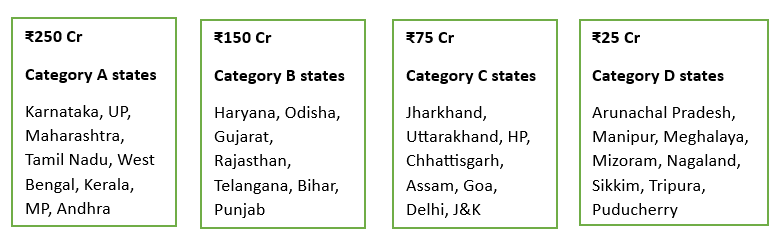
It ensures that emerging regions — particularly the northeastern states — are not left behind simply. Proportional incentivisation makes the reform both equitable and practical.
RoW as a catalyst — Powering economy-wide growth beyond telecom
Most importantly, this policy shift changes how we think about Right of Way. It’s no longer seen through a narrow, sector-specific lens. Instead, within the government’s evolving approach, RoW is being positioned as a horizontal enabler — a foundational layer that supports and accelerates other sectors.
Consider the industries that are directly dependent on physical digital infrastructure for their next phase of growth:
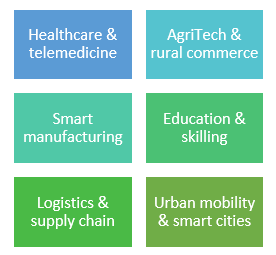
None of these sectors can digitise at scale without fibre and wireless infrastructure reaching deeper into districts, tehsils, and villages. A delayed RoW clearance in a district today translates into a delayed telemedicine clinic, a delayed precision-farming advisory, or a delayed last-mile payment terminal tomorrow. Digital infrastructure is not a vertical. It is the ground on which every other vertical stands.
From the ground up — A real-world lens
Use case
How faster tower clearances can transform healthcare access across a district
In a tribal district of Chhattisgarh, a primary health centre began rolling out a tele-consultation platform to connect patients with specialist doctors in Raipur. The system delivered strong results at the block headquarters, where 4G connectivity was stable. But in three sub-centres located 40–60 km away, connectivity was almost non-existent.
A tower site had already been identified and applied for. However, the Right of Way clearance, involving approvals from the forest department, the panchayat, and the state telecom authority, took nearly 18 months to come through.
The impact was immediate and real. Hundreds of patients who could have accessed remote diagnostics instead continued travelling 80 km round trips for consultations that could have been completed in a ten-minute video call.
What the new SASCI-linked framework changes is the timeline and the incentive structure. States like Chhattisgarh now have a direct financial push to resolve such cases, with a defined deadline and a clear processing benchmark.
What earlier took 18 months can now realistically be completed in six weeks, unlocking timely healthcare access for entire communities, not just connectivity.
Competition as a reform engine
One of the more underappreciated dynamics of the SASCI-RoW framework is the competitive pressure it deliberately introduces among states. Performance-linked incentives, published alongside clear milestones and timelines, create a public accountability loop. States that move faster on portal integration, backlog clearance, and processing time will capture more of the ₹4,000 crore pool — and will attract more investment.
This creates a virtuous cycle: better RoW processes attract faster network deployment, which attracts more digital businesses, which generates more state revenue, which enables more infrastructure investment. The government does not need to mandate this competition — it has designed incentives to make it emerge naturally.
The larger arc — Policy-led digital infrastructure as a global model
India’s approach here carries implications beyond its own borders. Developing economies across Asia, Africa, and Latin America face a similar problem: national digital ambitions are stalled at the state or provincial level by fragmented, slow regulatory environments for physical infrastructure. India’s SASCI-RoW model — linking sovereign lending instruments to specific, measurable regulatory reforms — offers a replicable template.
The framework ties the Telecommunications Act, 2023, and Row Rules, 2024, to on-the-ground implementation through financial incentives rather than mandates. It converts an administrative challenge into an economic opportunity for states. And it does so within existing fiscal architecture, without requiring new institutional machinery.
Right of Way is the backbone of India’s digital economy. Every fibre laid, every tower erected, every village connected begins with a clearance — and every clearance begins with a state’s willingness to act. For the first time, India has an incentive structure that clearly, proportionally, and at scale rewards willingness. That is not just good policy. It is the foundation of Viksit Bharat.







You must be logged in to post a comment Login