
Perspective
AI bubble — Challenges and opportunities

Artificial Intelligence has emerged as the defining technology of this decade, reshaping business strategies, public policy, capital markets, and workforce planning worldwide. With global investments running into hundreds of billions of dollars, record-breaking valuations of AI companies, and near-universal claims of “AI-first” transformation, the question of whether the world is witnessing an AI bubble has become increasingly prominent. Comparisons with the dot-com boom of the late 1990s are frequent, driven by similar patterns of exuberance, speculative investment, and inflated expectations.
However, history also teaches us that while technology bubbles often burst, they rarely disappear. Instead, they leave behind powerful infrastructure, new business models, and long-term productivity gains. The challenge, therefore, is not to dismiss AI as a bubble, but to understand the nature of the excess, the real risks involved, and the durable opportunities that will survive beyond the hype cycle
The scale of the AI surge — Hard data behind the narrative
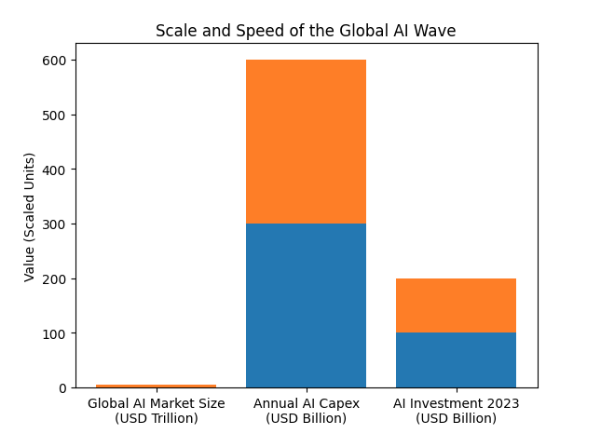
The current AI wave is unprecedented in both speed and scale. The global AI market, estimated at approximately USD 189 billion in 2023, is projected to grow to nearly USD 4.8 trillion by 2033, representing a 25-fold expansion within a single decade. This growth trajectory is far steeper than earlier technology revolutions, such as mobile internet or cloud computing.
At the infrastructure level, global spending on AI-related capital expenditure, including hyperscale data centres, high-performance GPUs, AI accelerators, cloud platforms, and advanced networking, has already crossed USD 300 billion annually. A small group of technology giants accounts for 60–70 percent of global AI compute capacity, leading to a highly concentrated ecosystem in which access to data, compute, and talent is increasingly unequal.
Venture capital and private equity investments in AI exceeded USD 100 billion in 2023, even as overall global VC funding declined. This divergence underscores both the perceived inevitability of AI and the risk of capital being deployed ahead of proven revenue models.
Why the “AI bubble” argument is gaining traction
Several structural factors explain why concerns of an AI bubble are not unfounded.
- Valuation and monetisation risks. Many AI startups are valued at 20 to 50 times forward revenues, significantly higher than historical technology benchmarks. In numerous cases, monetisation remains limited to pilot projects or enterprise experimentation, raising concerns about sustainability once investor patience wears thin.
- Enterprise readiness gap. Despite aggressive marketing, surveys indicate that nearly two-thirds of enterprise AI pilots fail to scale. Common barriers include poor data quality, lack of integration with legacy systems, insufficient domain expertise, and unclear accountability for AI outcomes.
- Compute and energy constraints: Training frontier AI models can cost hundreds of millions of dollars, while inference at scale demands continuous compute availability. By 2030, AI data centres could consume 3–4 percent of global electricity, up from around 1 percent today, raising serious questions about energy security, sustainability, and regulatory oversight.
- Workforce disruption anxiety
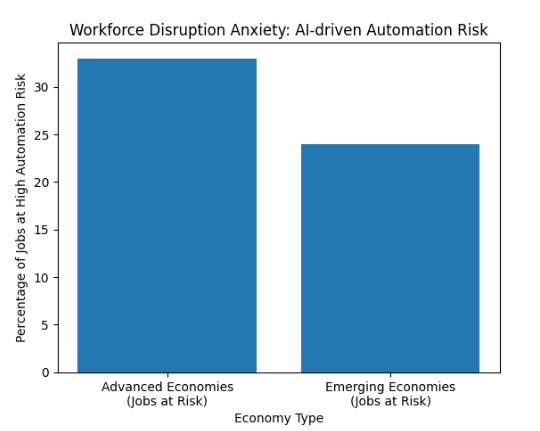
AI has revived fears of technological unemployment. Estimates suggest that 33 percent of jobs in advanced economies, and 24 percent of jobs in emerging economies, are exposed to high levels of automation risk if reskilling does not keep pace. This fuels public anxiety and political resistance, particularly in labour-intensive sectors.
Productivity reality — Evidence beyond the hype
While risks are real, empirical data strongly suggest that AI is already delivering measurable economic value.
Industries with high AI exposure, such as technology services, finance, telecom, and professional services, are experiencing nearly three times the revenue-per-employee growth of low-exposure sectors. Since 2022, productivity growth in these industries has almost quadrupled, reversing years of stagnation in knowledge-intensive work.
Wage data further reinforces this trend. Workers with AI-related skills such as data analysis, prompt engineering, AI system integration, and model supervision earn, on average, 50–60 percent higher wages. Importantly, employment levels are rising even in roles classified as “highly automatable,” as job content shifts rather than disappears.
This evidence challenges the simplistic narrative of AI as a job destroyer and positions it instead as a job transformer.
AI and the future of work — Augmentation over automation
The most significant impact of AI is not wholesale automation, but task-level augmentation. Routine, repetitive activities are increasingly handled by machines, while humans move toward roles requiring judgment, empathy, creativity, and oversight.
Key trends shaping the workforce include:
- Declining emphasis on formal degrees and rising focus on skills-based hiring,
- Rapid evolution of job roles, with AI-exposed occupations experiencing over 60 percent faster skill change, and
- Growth of hybrid roles combining domain expertise with AI literacy.
This transition, however, demands massive investment in reskilling and lifelong learning. Without it, AI risks deepening inequality rather than driving inclusive growth.
Agentic AI — The next inflection point
A critical shift underway is the move from tool-based AI to Agentic AI systems capable of planning, acting, and coordinating tasks autonomously within defined goals.
Early enterprise deployments show:
- 30–40 percent reduction in operational cycle times,
- Significant improvements in decision speed and consistency, and
- Reduced dependency on large operational teams.
Agentic AI represents a shift from efficiency gains to organisational redesign, in which AI acts as a digital co-worker rather than a background utility.
Strategic implications for India and emerging economies
For countries like India, the AI moment is both an opportunity and a risk. India accounts for over 15 percent of the global AI talent pool, yet captures a disproportionately small share of the economic value generated by AI.
The strategic opportunity lies in:
- Large-scale applied AI in telecom networks, digital governance, healthcare, agriculture, logistics, and smart infrastructure,
- Leveraging Digital Public Infrastructure (DPI) to democratise AI access, and
- Building sovereign AI capabilities aligned with national priorities rather than relying solely on foreign platforms.
Failure to act decisively could lock emerging economies into a role of AI consumers rather than AI value creators.
Governance, trust, and sustainability — The real differentiators
As AI adoption matures, governance will become as important as algorithms. Studies indicate that high-trust AI adoption can contribute up to 15 percent incremental GDP growth, while weak governance can delay benefits by several years.
Critical focus areas include:
- Transparency and explainability
- Bias mitigation and accountability
- Energy-efficient AI architectures
- Clear regulatory frameworks without stifling innovation
Trust is emerging as the most valuable currency in the AI economy.
From bubble to base layer — What comes next
Every major technology cycle follows a familiar pattern:
- Breakthrough innovation,
- Exuberant hype and overinvestment,
- Market correction,
- Consolidation and infrastructure maturity, and
- Broad-based diffusion and productivity gains.
AI currently sits between stages two and three. The inevitable correction will not signal failure; rather, it will filter weak business models, rationalise valuations, and strengthen long-term foundations.
Managing the transition, not fearing the bubble
Artificial Intelligence should not be viewed through the narrow lens of speculative excess alone. While elements of the current AI surge clearly exhibit bubble-like characteristics such as overvaluation, overpromising, and uneven readiness, the underlying technological trajectory is fundamentally different from past hype cycles that lacked deep economic integration. AI has already embedded itself into critical layers of infrastructure, enterprise decision-making, and public service delivery, making a full-scale collapse unlikely. What is far more probable is a period of correction that separates scalable, value-creating deployments from opportunistic experimentation.
The post correction phase will reward organisations and nations that treat AI as a systemic capability rather than a standalone technology. Enterprises that align AI with core business processes, invest in high-quality data, redesign workflows, and build human-AI collaboration models will continue to gain productivity and competitiveness even as speculative capital retreats. Conversely, entities that pursued AI largely for signaling value without institutional readiness or strategic clarity are likely to exit or consolidate.
From a workforce perspective, the AI transition demands proactive intervention. The coming decade will not be defined by the absence of jobs, but by the mismatch between evolving skill requirements and existing capabilities. Governments and industry must therefore prioritise large-scale reskilling, continuous learning ecosystems, and skills-based employment frameworks. Failure to do so risks social resistance to AI adoption, undermining its economic benefits and amplifying inequality.
For emerging economies, including India, the AI moment represents a strategic inflection point. The choice lies between becoming long-term consumers of externally developed AI systems or building domestic, application-led AI ecosystems aligned with national priorities such as digital governance, telecom networks, healthcare access, agriculture productivity, and infrastructure resilience. Leveraging digital public infrastructure, fostering sovereign compute capacity, and enabling open yet secure AI innovation will determine where value ultimately accrues.
Finally, trust, sustainability, and governance will define the durability of the AI era. As AI systems gain autonomy and scale, transparent decision making, ethical safeguards, energy efficient architectures, and clear accountability mechanisms will move from compliance requirements to competitive differentiators. Nations and enterprises that embed responsible AI frameworks early will accelerate adoption and unlock broader economic dividends.
In this context, the so-called AI bubble should be understood not as a warning of failure, but as a transition phase in a much longer transformation. Those who manage this transition with strategic patience, institutional preparedness, and societal alignment will convert today’s exuberance into lasting advantage. Those who do not may discover that when the bubble deflates, the real opportunity has already passed.
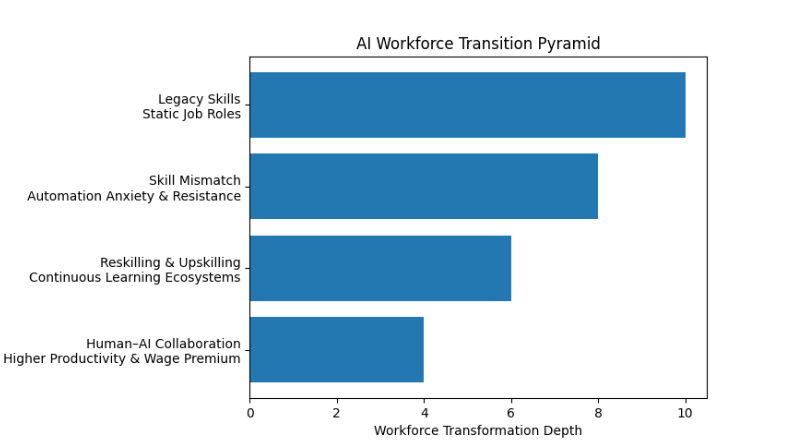
The AI workforce transition is not defined by job loss, but by the movement from legacy roles through a period of skill mismatch toward a mature state of human-AI collaboration enabled by large-scale reskilling and continuous learning.









You must be logged in to post a comment Login