
AI
The Jevons Moment: AI is the biggest opportunity in Indian IT’s history
For three decades, India’s technology services industry has had a reliable relationship with disruption: every technology shift that was supposed to make it redundant ended up making it larger. Artificial intelligence is the latest, and by far the most consequential, test of that pattern. The early signals suggest the pattern is holding. But this time, something more fundamental than market size is changing. The industry’s identity is changing.
Three waves, one pattern
India’s IT services story unfolded in three distinct phases, each separated by a technology transition that, at the time, seemed like a potential disruption.
The first wave was Y2K and the offshore model. The late 1990s established that complex, large-scale software work could be delivered remotely by Indian engineers at a fraction of the cost of Western alternatives. The model was simple: talent arbitrage. India had engineers; the West had problems. The offshore delivery centre was the defining institution of this era.
The second wave was cloud and digital transformation. Through the 2000s and 2010s, cloud computing threatened to commoditise the infrastructure management and application development work that Indian IT had built its revenues on. It did not. Instead, the shift to cloud created a transformation cycle, migrating legacy systems, redesigning applications, retraining workforces, that was larger in dollar value than the work it replaced. India’s IT sector grew from roughly USD 50 billion in revenues in 2010 to over USD 250 billion by FY25, a fivefold expansion across the supposed era of commoditisation.
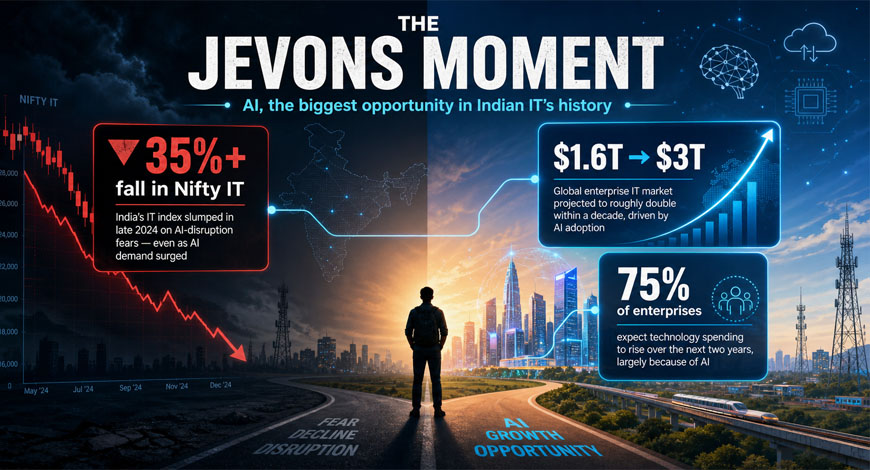
The third wave is artificial intelligence. In late 2024, the arrival of agentic AI systems capable of writing code, running operations, and managing routine tasks autonomously triggered a sharp market correction. India’s Nifty IT index fell more than 35 percent. Analysts wrote about structural displacement. The mood was close to existential.
Margins held. Revenues grew. Deal pipelines hit multi-year highs. The pattern repeated. But the reason it repeated this time is different in kind, not just degree, and understanding that difference is what makes this moment genuinely historic.
The Jevons dynamic: Why cheaper intelligence means more demand
In 1865, the British economist William Stanley Jevons identified a paradox that has since proven to be one of the most reliable laws in the economics of technology. Improvements in the efficiency of steam engines, he observed, had not reduced Britain’s coal consumption; they had massively increased it. When a powerful resource becomes cheaper to use, it does not simply substitute for existing applications. It makes entirely new ones viable, across industries and at scales that were previously uneconomical.
The pattern has held across every major technology transition since: oil and the internal combustion engine, electricity and industrial manufacturing, the microprocessor and the personal computer, the internet and the information economy. In each case, efficiency gains expanded the total market rather than shrinking the existing one. Demand did not converge to the new efficiency; it grew to fill the new possibility space.
Artificial intelligence is following the same logic at extraordinary velocity. The cost of performing a unit of cognitive work, analysis, reasoning, code generation, and pattern recognition has declined by approximately 90 percent every twelve to eighteen months since 2022, a rate of price compression without precedent in the history of technology. With these economics, intelligence becomes viable for applications, industries, and organizations that could not previously afford it. The market for enterprise technology services does not contract when intelligence gets cheaper. It widens.
The global enterprise IT market stands at approximately USD 1.6 trillion today. Independent forecasts from Gartner, McKinsey, and KPMG converge on a projection of USD 3 trillion within the next decade. Three-quarters of global enterprises expect technology spending to increase over the next two years, driven primarily by AI adoption. This is the Jevons Moment: not a threat to manage, but a market expansion on a scale the industry has never seen.
From factory to architect: The identity shift
What is different this time is not the size of the opportunity, although it is extraordinary. What is different is the nature of the work the opportunity demands. And that is changing what Indian IT fundamentally is.
The offshore model was, at its core, an execution model. A client in London or Chicago defined a problem, designed a solution, and engaged an Indian firm to build and maintain it. The value proposition was reliable, cost-efficient delivery: a factory for software. This was not a small thing; it required genuine engineering excellence and a quality of institutional reliability that took years to build. But the intellectual centre of gravity sat with the client.
The AI era is inverting that relationship. The complexity of what enterprises need to do, integrate AI into fragmented legacy architectures, redesign end-to-end workflows around agentic systems, govern AI compliance under rapidly evolving regulatory frameworks, and build sovereign infrastructure for states, cannot be specified upfront by a client who does not understand the technology. It requires a partner who understands both the technology and the enterprise. That is a different role: not factory, but architect.
This shift is already visible in how the largest IT services deals are being structured. The proportion of contracts that involve strategic advisory, transformation design, and outcome-based accountability, rather than pure staff augmentation or project delivery, has grown substantially. Clients are not buying engineer-hours; they are buying judgment about what to build, how to govern it, and what it will actually deliver. That is architect-level work, and it commands architect-level pricing.
The five domains in which this architectural capability is most in demand are well defined. Legacy modernisation, rebuilding the fragmented, ageing technology stacks that are the precondition for any AI deployment, represents perhaps USD 1.5 trillion in annual productivity losses across the global economy today. Business process reimagination, redesigning workflows from the ground up for AI-native operations, is where McKinsey estimates USD 2.6 to USD 4.4 trillion in annual value creation is available. AI governance, the permanent, ongoing work of managing, monitoring, and ensuring compliance in AI systems that learn, drift, and require oversight, is the new recurring revenue model of the sector. Sovereign AI, building state-controlled AI infrastructure for governments that will not accept foreign dependency on their most sensitive data, is a long-duration, high-trust opportunity that plays directly to Indian IT’s regulatory relationships and geopolitical neutrality. And physical AI, the integration of intelligence into factories, logistics networks, energy infrastructure, and healthcare systems, is where the convergence of software expertise and operational technology knowledge will produce the next generation of complex, high-value engagements.
The scarcest resource: Trusted intelligence
There is a version of the AI future in which intelligence becomes so abundant and so cheap that it is effectively a commodity, available to anyone, differentiated by no one. In that world, the question of who delivers AI-powered services matters very little. Price and speed are everything.
That is not the world that enterprise clients are navigating. The world they are navigating is one in which AI is powerful, proliferating, and poorly understood by the institutions that must deploy it accountably. In financial services, healthcare, government, defence, and critical infrastructure, AI cannot simply be switched on. It must be integrated into compliance frameworks that span multiple regulators and jurisdictions. It must be explainable to boards and auditors. It must be governed against failure modes that carry legal, financial, and reputational consequences. And it must be delivered by a firm that will still be accountable for it five years from now.
The European Union’s AI Act, fully in effect since 2024, is the leading edge of a regulatory wave that will sweep every major economy. It imposes mandatory conformity assessments, human oversight requirements, and ongoing monitoring obligations on high-risk AI applications across healthcare, financial services, law enforcement, and critical infrastructure. Equivalent frameworks are advancing in the United States, India, the United Kingdom, and the Gulf. Navigating this landscape requires not just technical capability but deep, jurisdiction-specific regulatory knowledge, the kind that accumulates over years of operating within the institutions regulators oversee.
This is where Indian IT’s 30-year track record becomes a structural asset rather than merely a historical footnote. The firms that have spent decades managing the technology backbone of global banks, insurers, healthcare systems, and government agencies have accumulated precisely the regulatory knowledge, the client relationships, and the delivery credibility that the AI governance era demands. New entrants with superior AI tools but no institutional history cannot replicate that in a product cycle. The trust premium that established IT services firms carry is the most durable competitive advantage in the enterprise market, and it is the one advantage that AI tools do not diminish.
The domestic multiplier: India as client
Every previous wave of Indian IT growth was primarily an export story. Indian talent and capability served foreign enterprises; the domestic economy was largely a training ground and a labour pool. The AI era adds a second engine: India itself.
India has, over the past decade, built a public digital infrastructure, the India Stack, that is without precedent among large economies. The Unified Payments Interface processes over 18 billion transactions per month. Aadhaar covers more than 1.4 billion registered identities. The ONDC network is digitising retail commerce. The Ayushman Bharat digital health mission is creating a unified patient data ecosystem. DigiYatra is biometrically integrating air travel. These systems are not just digital public goods, they are AI-ready data infrastructure at national scale, and they are generating demand for a new generation of AI-native applications across financial services, healthcare, agriculture, logistics, and urban management.
The Indian government’s AI mission, backed by substantial investment in compute infrastructure and a policy framework that encourages both public and private AI development, is creating a domestic market for enterprise AI that simply did not exist a decade ago. Indian IT firms, uniquely positioned to understand both the technical architecture of the India Stack and the regulatory and political context in which it operates, have a home-market advantage in this space that foreign competitors cannot easily replicate. The domestic opportunity adds a growth dimension to the AI era that is entirely new in the industry’s history.
Earning the moment
The Jevons Moment is real. The market expansion it implies is well-supported by data and structural logic. But it is not distributed automatically across all firms in the sector. It concentrates on those who invest ahead of demand in the capabilities the new era requires.
Inside the major IT services firms, the transformation is already underway. Software engineering is reorganising around human-and-agent delivery teams, where AI agents handle code generation and testing while engineers focus on architecture, problem framing, and accountability. Productivity benchmarks at several large firms suggest agent-augmented engineers deliver two to three times the output of their unaugmented counterparts on well-defined tasks. New professional roles, agent engineers, AI governance specialists, transformation advisors, sovereign AI architects, and assurance partners are forming around the specific demands of enterprise AI deployment. Each combines technical depth with domain knowledge in proportions that take years, not months, to develop.
The firms that capture this moment will be those that complete their identity transition: from organisations that execute to specification, to organisations that define what should be built, take accountability for how it performs, and govern it over time. That is a more demanding identity. It requires deeper investment in talent, domain expertise, and client relationships from which a genuine understanding of the enterprise context is drawn. It is also a far more valuable one.
India’s IT sector did not earn its global position by being the lowest-cost option, though it was often that too. It earned it by being the most adaptable, the most reliable, and ultimately the most trusted partner for the institutions that actually run the world’s economy. The Jevons Moment, the point at which falling cost of intelligence triggers an explosion in demand for those who can deploy it accountably, is the moment for which three decades of institution-building have been the preparation. The industry that built itself on doing the hard work inside the world’s most demanding enterprises is standing at the beginning of its largest opportunity yet. What it does with that position in the next five years will define it for the next thirty.











You must be logged in to post a comment Login