
Headlines of the Day
India must build technology-neutral regulation to lead global space, Lahoti
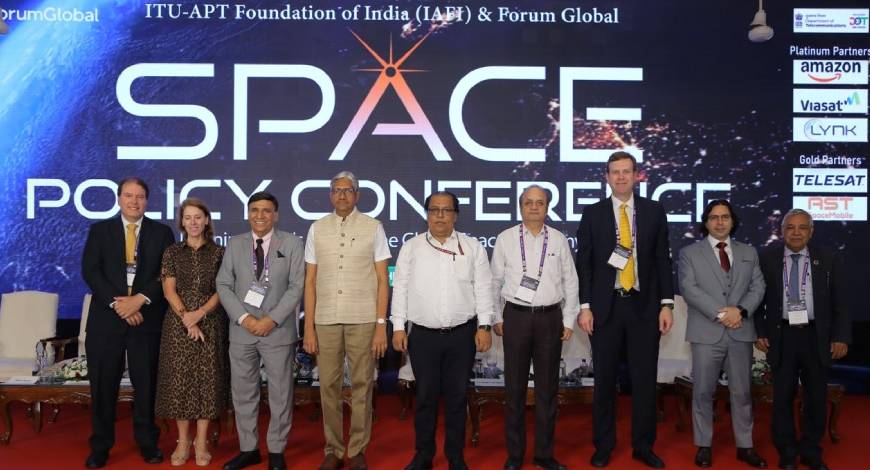
“India’s space economy has entered a period of unprecedented expansion. As satellite communications become increasingly central to the digital economy, the country needs a transparent, technology-neutral and forward-looking regulatory framework that promotes innovation, competition and efficient spectrum utilisation.” With this message, Chief Guest Anil Kumar Lahoti, Chairman, Telecom Regulatory Authority of India (TRAI), inaugurated the Third Space Policy Conference 2026, jointly organised by the ITU-APT Foundation of India (IAFI) and Forum Global, setting the tone for two days of high-level international dialogue on the policies, regulations and technologies that will define India’s place in the global space economy.
Held at The Imperial, New Delhi, the conference brought together more than 150 policymakers, regulators, satellite operators, technology companies, international organisations and industry leaders from India and across the world to deliberate on the opportunities and challenges shaping the rapidly evolving space ecosystem.
Welcoming the distinguished gathering, Bharat Bhatia, President, ITU-APT Foundation of India (IAFI), opened his address with a video of the successful launch of Vikram-1, India’s first privately designed, developed and manufactured rocket, describing it as a defining milestone in India’s commercial space journey. Reflecting on IAFI’s long-standing contribution to global telecommunications and spectrum policy through more than 500 technical submissions to ITU and APT forums, he said the conference was taking place at a transformational moment for India’s space sector.
“India today has a unique opportunity to emerge as a major force in the global space economy. Progressive policy reforms, private sector participation and international collaboration are reshaping the sector at an unprecedented pace. Through this conference, IAFI aims to facilitate informed dialogue among governments, regulators and industry so that India develops a globally competitive, innovation-friendly and future-ready policy ecosystem that accelerates investment, strengthens connectivity and advances sustainable growth of the space sector,” Bharat Bhatia said.
The inaugural session reflected the increasingly global nature of India’s space ambitions. Chris Hofer, Head, International Spectrum Management and Strategy, Amazon Leo, highlighted Amazon’s plans to connect underserved communities through its rapidly expanding low Earth orbit constellation and identified India as a strategic market for satellite broadband. Cristian Gomez, Vice President, Government & Regulatory, Asia Pacific, Viasat NTN, emphasised that non-terrestrial networks are designed to complement rather than compete with terrestrial infrastructure, while outlining Viasat’s collaboration with BSNL on India’s first direct-to-device demonstration. Thomas S. Hastings, Associate Chief, FCC Space Bureau, United States Federal Communications Commission, presented the United States’ regulatory approach to encouraging innovation through streamlined licensing, satellite-terrestrial integration and modernised spectrum coordination.
Representing the Government of India, NK Bhola, Wireless Advisor, Department of Telecommunications, Government of India, stressed the importance of efficient spectrum management to ensure harmonious coexistence between satellite and terrestrial services while reaffirming India’s active engagement in ITU and APT preparations for WRC-27. Isabelle Mauro, Director General, GSOA, called for regulatory certainty, rational spectrum pricing and timely spectrum availability to unlock investment in satellite communications. Deb Kumar Chakrabarti, Member (Services), Department of Telecommunications, Government of India, outlined India’s ambition to become one of the world’s leading space economies by strengthening domestic manufacturing, expanding downstream services and accelerating institutional reforms. Manish Sinha, Member (Finance), Department of Telecommunications, Government of India, highlighted the transformational impact of the Indian Space Policy 2023 and recent regulatory measures that support a sustainable commercial satellite ecosystem. The inaugural session concluded with a vote of thanks by Satyen Gupta, Secretary General, ITU-APT Foundation of India (IAFI).
Delivering the keynote address, Lahoti congratulated IAFI for bringing together global experts to deliberate on issues of strategic national importance. He outlined TRAI’s recent recommendations under the Telecommunications Act, 2023, including a unified authorisation framework for satellite services, a transparent revenue-sharing model for satellite spectrum assignment, and new authorisation frameworks for satellite gateways, satellite communication networks and direct-to-device services. He emphasised that satellite communications would be indispensable in providing seamless connectivity to remote and underserved regions while supporting India’s emergence as a globally competitive digital economy.
The conference’s first technical session, “From Policy to Implementation – Is India’s Space Framework Delivering?”, chaired by Dr PK Jain, Director, PMAD, IN-SPACe, Department of Space, Government of India, examined whether India’s landmark policy reforms were translating into commercial implementation. Lieutenant General Anil Kumar Bhatt (Retd.), Director General, Indian Space Association (ISpA), praised the progress made in launch services while calling for the early enactment of the Space Activities Bill to unlock further investment. Dr. Laura Roberti, Director for Spectrum & Market Access, Telesat, urged simplification of India’s complex regulatory approval processes and timely spectrum decisions for NGSO systems. Amy Melman, Executive Vice President and Chief Global Affairs Officer, Lynk, advocated lighter licensing frameworks that accelerate commercial deployment, while Rakesh Kapoor, Consultant NGSO Broadband Deployment, former Indian Telecom Service officer and retired Executive Director, Core Network, BSNL, called for a faster transition towards LEO-based satellite systems. Tarun Chitkara, Vice President, Regulatory Affairs, Bharti Airtel, emphasised that industry was fully prepared to launch services as soon as spectrum and authorisations become available.
A special fireside discussion on Global Regulatory Framework for Non-GSO Satellite Systems featured Chris Hofer in conversation with Pankaj Sharma, Partner, Regulatory Consulting, EY. The discussion focused on the need to modernise international spectrum regulations, update legacy EPFD limits using contemporary operational data, and prepare regulatory frameworks for the convergence of satellite, 5G and future 6G networks.
The second session, “WRC-27 – The Final Stretch,” chaired by Amit Gulati, Senior Deputy Wireless Advisor, Department of Telecommunications, examined the international decisions that will shape the future of global spectrum policy. Arun Kumar, Deputy Wireless Advisor, Wireless Planning & Coordination Wing, Department of Telecommunications, outlined India’s preliminary positions on major WRC-27 agenda items. Cristian Gomez, Dr. Laura Roberti, Jose Pepe Fiu Vidal, Amazon Kuiper, and Dr. Sendhil Kumar Devar, Ericsson India, discussed issues ranging from non-terrestrial networks and NGSO spectrum harmonisation to future IMT spectrum requirements, underscoring the importance of globally harmonised outcomes for innovation and next-generation connectivity.
The afternoon session, “Competition & Licensing – Has a Level Playing Field Emerged?”, chaired by Syed Tausif Abbas, Senior DDG & Head, Telecommunication Engineering Centre (TEC), Department of Telecommunications (DoT), Government of India, and CMD, TCIL, explored whether India’s evolving regulatory framework adequately balances satellite and terrestrial communications. Arun Agarwal, Principal Advisor (NSL), Telecom Regulatory Authority of India (TRAI), highlighted TRAI’s ongoing work on a transparent satellite communication network authorisation framework. Faheem Sheikh, Primary Lead, Licensing & Regulatory Affairs, South Asian Countries, Amazon Kuiper, pointed to regulatory asymmetries affecting satellite operators. Prabhat Dixit, DDG (Satellite), Department of Telecommunications, explained the June 2026 authorisation framework integrating satellite services into the mainstream telecom licensing regime while maintaining national security safeguards. Vikram Tiwatia, Senior Advisor, Cellular Operators Association of India (COAI), reiterated that satellite and terrestrial networks are complementary technologies, while Ethan Mudavanhu, Regulatory Affairs Lead, Asia, Africa & Middle East, Sateliot, called for technology-neutral and proportionate regulation that accommodates diverse satellite service models.
The conference concluded its first day with a dedicated session on Space Infrastructure Security, organised by the Cyber Security Association of India (CSAI) and moderated by R Shakya, Additional Director General Telecom & Head, Haryana LSA, Department of Telecommunications, Government of India. M. Raj Anoop, Director, Security Policy, Department of Telecommunications, advocated a secure-by-design approach across the satellite lifecycle to counter cyber threats, orbital debris and signal interference. Siddharth Sabharwal, Director, Security Assurance, Department of Telecommunications, highlighted cybersecurity vulnerabilities and evolving regulatory measures. Prabhat Dixit, DDG (Satellite), Department of Telecommunications, outlined India’s security requirements under the Telecommunications Act, 2023 and the June 2026 authorisation framework. Lieutenant General Anil Bhatt (Retd.), Director General, Indian Space Association (ISpA), called for a national space cybersecurity policy and recognition of space infrastructure as critical infrastructure, while Amit Sharma, Founder & Managing Director, Amitec Electronics Ltd., emphasised strengthening the security of ground infrastructure as an essential pillar of India’s expanding space ecosystem.
The conference will continue today, Thursday, with discussions on emerging satellite technologies, spectrum management, direct-to-device communications, international collaboration, sustainability and the policy roadmap required to strengthen India’s position as a trusted and globally competitive space power.
CT Bureau












You must be logged in to post a comment Login