
CT’s Take
TRL Compass-Building India’s future network needs more than bandwidth

India’s telecom ambition has never been louder. The country is committed to deploying 6G commercially by 2030. It is building an indigenous Open RAN ecosystem. It is investing in private 5G networks for manufacturing, logistics, and smart cities. It is attempting to create an exportable telecom technology stack- the equipment, software, and systems that global operators will purchase- that carries the ‘Made in India’ label. These are not modest goals. They require translating fundamental research into field-deployable, standards-compliant, operator-grade products at a pace that India’s R&D ecosystem has not historically demonstrated.
The launch of the TRL Compass Platform on June 29, 2026 by the Office of the Principal Scientific Adviser (OPSA), in collaboration with the Data Security Council of India (DSCI), is directly relevant to this ambition, even though the platform’s current sector-specific annexures are focused on Healthcare & Pharmaceuticals and Software. The underlying framework and the infrastructure for technology readiness assessment it is building address a structural problem at the heart of India’s telecom R&D challenge: the absence of a shared, rigorous, objective standard for evaluating whether a network technology is genuinely ready to leave the laboratory.
Telecom’s valley of death is wider than most sectors
Every innovation ecosystem has a Valley of Death, the treacherous middle ground between a promising research result and a product deployable at scale. In telecom, this valley is unusually wide. A novel 5G baseband algorithm that performs brilliantly in simulation must survive hardware implementation, then protocol compliance testing, then interoperability validation against third-party equipment, then field trials in actual RF environments, then operator acceptance testing, then regulatory approval, before it can be considered a deployable product. Each of these stages is a distinct and demanding evidence gate.
India’s telecom research institutions- IIT Delhi’s Bharti School of Telecommunication, IIT Bombay’s Wireless Research Lab, C-DoT (Center for Development of Telematics), and the recently established TSDSI (Telecommunications Standards Development Society, India)- are producing technically credible research. The country has made real progress on indigenous LTE and 5G core development, contributed to international standards bodies, and built early-stage O-RAN components. The challenge is not research quality. It is the handoff, from a working prototype in a controlled environment to a product that a telecom operator or enterprise network manager will trust enough to deploy.
The handoff problem: India’s telecom labs can build a working 5G gNB component. What they struggle to demonstrate, in a language that operators and investors understand, is whether it is at TRL 5, TRL 7, or TRL 9. TRL Compass provides that language.
This is precisely the problem TRL Compass is designed to address. By establishing objective, documentation-backed assessment criteria for technology, manufacturing, quality, and programmatic readiness, the platform creates a common vocabulary that can connect a telecom research group at an IIT with a procurement decision-maker at a telecom operator, or with a funding committee at the Anusandhan National Research Foundation (ANRF). Without that vocabulary, the conversation defaults to subjective judgment and institutional reputation, which systematically disadvantages newer research entrants and smaller innovation companies.
What TRL looks like across the telecom stack
TRL compass: Telecom & enterprise network technology mapping
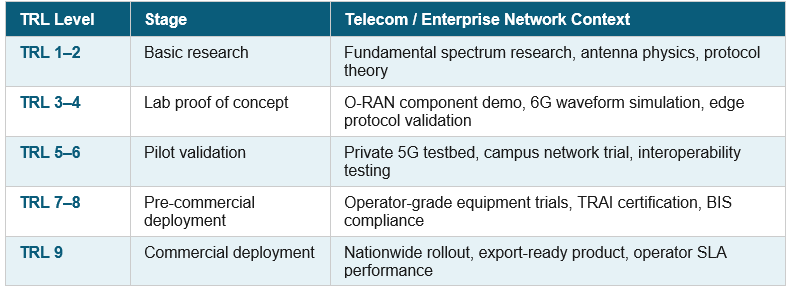
The nine-level TRL scale maps naturally onto the telecom development pipeline, but the evidence requirements at each stage are distinctively demanding. A research group claiming TRL 5, ‘technology validated in relevant environment’, in a 6G context would need to demonstrate, at minimum, that its waveform design has been tested in conditions representative of real-world propagation, that the hardware implementation meets minimum latency and throughput specifications, and that the component interfaces with adjacent system elements in a standards-compliant manner. A claim of TRL 7, ‘system prototype demonstration in operational environment’, would require field trial data from a live or near-live network environment, operator involvement in the validation process, and documented compliance with relevant TSDSI or 3GPP specifications.
The current TRL Compass framework does not yet include a telecom-specific annexure. The initial release covers Healthcare & Pharmaceuticals and Software, sectors where OPSA and DSCI have the deepest immediate institutional relationships. But the framework’s underlying architecture is explicitly designed for sector extensibility, and the MoU between OPSA and DSCI includes a mandate to develop the Technology Radar methodology and expand capability mapping across India’s deep-tech landscape. A telecom and enterprise network annexure is not a distant aspiration, it is the logical next step for a government that is simultaneously running a 6G Mission and a PLI scheme for telecom equipment.
Platform opportunity: A telecom-specific TRL Compass annexure, co-developed with TSDSI, C-DoT, and the Department of Telecommunications, could be the single most impactful policy tool for India’s indigenous telecom equipment ambition.
6G Mission: Where research rigour meets national stakes
India’s 6G Mission, launched under the Bharat 6G Vision document, sets an explicit target to develop and deploy 6G technology by 2030. Achieving this requires the country to move from foundational research, spectrum characterisation, terahertz propagation studies, intelligent surface antenna design, through technology development and into pre-commercial trials within a compressed timeline that the global telecom industry is also racing against.
The 6G Mission is being funded through a combination of government grants, ANRF allocations, and private sector co-investment incentives. Multiple research consortia, spanning IITs, NITs, C-DoT, and private sector participants including TCS, Infosys, and L&T Technology Services, are pursuing parallel research tracks. The challenge that TRL Compass directly addresses is how to evaluate the relative maturity of these parallel research streams, make rational public funding allocation decisions, and identify which technologies are genuinely ready to transition from research to development phase.
Without a standard assessment framework, funding allocation risks being driven by proposal quality rather than technology maturity, rewarding those who write better grant applications, not those who have built more mature and deployable technology. TRL Compass changes this equation. It creates a documented evidence standard that funding agencies can use to evaluate where in the development pipeline a 6G research project actually sits, and to prioritise support for projects that can credibly demonstrate progress toward deployment-grade readiness.
6G funding logic: India cannot afford to discover in 2028 that its 6G investments funded technology that was at TRL 3 when it needed to be at TRL 6. TRL Compass gives ANRF the tools to make that distinction prospectively.
O-RAN and the indigenous equipment imperative
Open RAN, the disaggregated radio access network architecture that separates hardware from software and enables multi-vendor interoperability, is India’s most significant near-term opportunity in global telecom equipment markets. Whereas the legacy RAN market is dominated by Ericsson, Nokia, and Huawei, the O-RAN ecosystem is structurally more open to new entrants, and India has invested substantially in building O-RAN capabilities through C-DoT, Tejas Networks, VVDN Technologies, and a growing cohort of deep-tech startups.
BSNL’s commercial deployment of an indigenous 4G network, built on C-DoT core technology and domestic radio equipment, was a landmark demonstration that Indian telecom technology can move from laboratory to operational deployment. But it also exposed the scale of the challenge: the project faced significant timeline delays, and the equipment’s performance in live network conditions required substantial field optimisation before meeting operator-grade reliability standards. These are precisely the indicators of a technology that moved from laboratory to deployment without adequate intermediate validation, a Valley of Death crossing that cost significant time and money.
A rigorous TRL-based assessment framework, applied to O-RAN components before they enter operator trial phases, would catch these gaps earlier in the pipeline. A radio unit claiming TRL 6 readiness would need to demonstrate interoperability with multiple third-party O-RAN components, compliance with O-RAN Alliance test specifications, and performance validation in an environment representative of the intended deployment conditions, before entering a live network trial. The cost of catching a gap at TRL 6 is a fraction of the cost of discovering it during a BSNL deployment.
Industry signal: Tejas Networks, VVDN, and the C-DoT ecosystem need a shared, credible TRL framework not just for government funding, but to communicate readiness to global O-RAN partners and international operators they hope to supply.
Private 5G and enterprise networks: A different readiness challenge
Beyond public telecom infrastructure, India is witnessing rapid growth in private 5G networks for enterprise use cases, manufacturing shop floors, port operations, smart campuses, defence installations, and mining sites. This market segment has a distinct technology readiness profile from public network infrastructure: the evidence requirements for a private 5G deployment serving a single enterprise client are different from those for a nationwide public operator rollout.
Enterprise network buyers, CIOs and technology heads at large Indian corporates and public sector undertakings, are currently navigating private 5G procurement decisions with limited objective information about the maturity of the technology solutions being pitched to them. Indian vendors offering private 5G solutions range from genuinely deployment-ready integrators to companies packaging largely imported components with limited local value-add. The absence of a standard readiness assessment framework makes it difficult for enterprise buyers to distinguish between them.
TRL Compass, with an enterprise network annexure, could serve a procurement intelligence function in this market. An enterprise IT procurement team evaluating two competing private 5G vendors could request TRL Compass assessment documentation as part of the RFP process, asking each vendor to provide evidence-backed assessments of their technology maturity, manufacturing readiness, and quality management systems. This shifts the conversation from marketing claims to documented evidence, and creates pressure on vendors to invest in genuine technology maturation rather than positioning.
Enterprise procurement: Requiring TRL documentation in private 5G RFPs would be a low-cost, high-impact intervention that separates deployment-ready solutions from vaporware in a market currently short of objective evaluation standards.
DSCI’s role: Network security as a readiness dimension
The involvement of the Data Security Council of India in TRL Compass is particularly significant for the telecom and enterprise network sector, where cybersecurity is not a supplementary consideration but a core dimension of technology readiness. A 5G core network component that has not been assessed for security vulnerabilities, that lacks a documented software bill of materials, or that has not been evaluated against TRAI’s security framework cannot be considered deployment-ready, regardless of its RF performance or protocol compliance.
DSCI’s mandate, which has historically encompassed technology forecasting, horizon scanning, and cybersecurity capability mapping, aligns naturally with the security readiness dimension of telecom technology assessment. The MoU between DSCI and OPSA explicitly includes capability mapping and the development of a Technology Radar methodology, which could incorporate network security maturity as an assessed dimension alongside the standard TRL technology and manufacturing readiness criteria.
For telecom equipment vendors seeking to export Indian-developed 5G and O-RAN products to international markets, security assurance documentation is increasingly a de facto requirement for market access. The European Union’s 5G Security Toolbox, for example, specifies risk assessment criteria for vendor certification that include software supply chain security and vulnerability disclosure practices. A TRL Compass framework that incorporates security readiness assessment, leveraging DSCI’s expertise, would give Indian telecom vendors a documented, internationally legible security assurance posture that enhances their export competitiveness.
Export readiness: Security certification is table stakes for Indian telecom products in European, Middle Eastern, and Southeast Asian markets. DSCI’s involvement in TRL Compass creates a pathway to building that certification infrastructure domestically.
What the telecom industry should do now
TRL Compass is live. The framework is publicly available at trlcompass.in. The pool of trained assessors is being built. The question for India’s telecom and enterprise network ecosystem is how quickly it moves from awareness to active adoption, and how effectively it shapes the platform’s evolution to serve its specific needs.
The most immediate opportunity for the telecom sector is engagement with OPSA and DSCI on the development of a telecom-specific annexure. The sector bodies best placed to lead this engagement are TSDSI, the Broadband India Forum, the Internet and Mobile Association of India’s enterprise connectivity working group, and the telecom vertical of NASSCOM’s deep-tech initiative. A co-developed telecom annexure, built with input from operators, equipment vendors, enterprise network deployers, and the research institutions driving 6G, would be significantly more useful than a generic technology framework applied by analogy.
For individual companies in the sector, the immediate value of TRL Compass is as an internal discipline tool. Research groups and product teams that begin applying TRL thinking to their technology roadmaps, mapping their development milestones against documented evidence requirements, identifying readiness gaps before they become deployment failures, are building the institutional capability that the framework is designed to encourage. The companies that adopt this discipline now will be better positioned for ANRF funding rounds, better prepared for operator trial conversations, and better equipped to communicate their technology maturity to international partners.
India’s telecom ambition is real. The research capability is growing. The government’s commitment, through the 6G Mission, the PLI scheme, and now the TRL Compass Platform, is substantial. What has been missing is the connective tissue between ambition and deployment, the shared framework that keeps everyone in the innovation pipeline speaking the same language about readiness. TRL Compass is that connective tissue. The telecom sector’s job now is to wire it in.
CT Bureau








You must be logged in to post a comment Login