
CT’s Take
Energy management-The AI use case telcos can’t afford to ignore
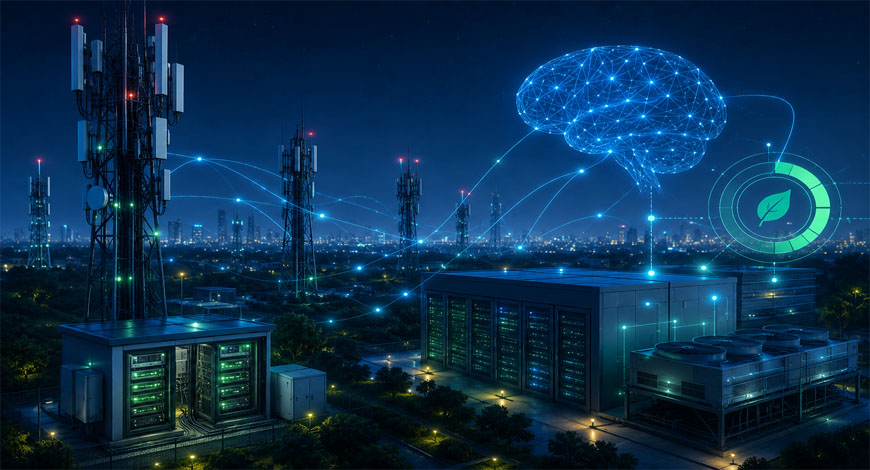
For more than a decade, telecom operators have chased artificial intelligence for everything except the one line item that hurts them daily: energy. Billing, churn prediction, customer care bots and fraud analytics have all had their moment in the sun. Yet the single biggest operating cost in a mobile network, the power consumed by radio sites, towers, cooling systems and data centers, has largely remained the domain of static heuristics and vendor-specific optimization features. That is now changing. As Indian operators race to monetise 5G while staring at flat tariffs, rising electricity prices and aggressive sustainability expectations, energy management is rapidly becoming the most compelling AI use case in the network.
The timing is no accident. India’s mobile networks are expanding in two directions simultaneously: deeper, denser 4G and 5G coverage into semi-urban and rural markets, and heavier capacity layers in metros to support video, gaming and enterprise traffic. Every new site, every additional carrier, every incremental Massive MIMO sector adds to the energy bill. In parallel, data centre capacity, whether operator-owned, neutral or cloud, is growing to support 5G cores, content delivery, private networks and, increasingly, AI compute itself. The result is a structural squeeze: telcos are under pressure to deliver more bits per second, to more users, over more infrastructure, but with little room to pass rising energy costs on to subscribers. Against this backdrop, AI-driven energy optimisation is shifting from “interesting innovation” to operational necessity.
What makes energy such a natural fit for AI is the problem’s dynamic, multi-variable character. Conventional power-saving schemes in radio access networks were designed around relatively simple rules: switch off carriers during deep off-peak hours, reduce transmit power in lightly loaded cells, or apply predefined sleep modes. Those approaches helped, but their impact has plateaued. They treat the network as a static grid, not a living organism whose traffic pulses minute by minute, neighbourhood by neighbourhood. AI, by contrast, thrives on exactly this kind of complexity. Models can ingest live telemetry from thousands of cells, towers and cooling systems, learn the relationships between traffic patterns, quality-of-service thresholds and energy use, and then decide, in near real time, which cells should run at full power, which can be dimmed and which can be put to sleep without hurting experience.
In a dense urban cluster, that difference is tangible. Consider a pocket of Delhi where traffic peaks sharply in the evening, then falls off a cliff after midnight. Today, many networks still run a relatively generous power profile during night hours, either because configuration is coarse or because operators prefer to avoid the risk of degradation. An AI energy management layer can observe the actual traffic curve over weeks, classify the types of usage in that locality, infer safe thresholds for downlink and uplink performance, and learn that, say, from 01:00 to 04:30 a subset of carriers and sectors can be switched off while others operate at reduced power. It can simultaneously adjust parameters at the tower site, from air-conditioning set points to battery charging cycles, to flatten peaks and lower consumption. The cumulative effect, across thousands of such micro-decisions every night, is a meaningful reduction in kilowatt-hours that translates directly into savings.
For Indian operators, the stakes are higher because of the composition of their energy use. Radio access networks account for the majority of a mobile operator’s power consumption, but the long tail of passive infrastructure, diesel generators, batteries, rectifiers, indoor cooling, backhaul equipment, adds layers of inefficiency, especially at older or rural sites. Historically, “green tower” initiatives attacked this problem with hardware: more efficient rectifiers, better batteries, solar panels or hybrid sites. Those investments remain important, but they are capital-intensive and slow to scale. AI adds a software-first dimension. Algorithms can decide when to lean more on solar or grid power based on load forecasts, can stagger battery charging to avoid simultaneous spikes across regions, and can recommend the optimal upgrade sequence by identifying the sites where a change in equipment will yield disproportionate benefits.
The conversation does not stop at towers. As 5G cores, edge clouds and AI compute clusters take shape in India, data centres are becoming the second great arena for energy-focused AI. Here, the variables include server utilisation, workload placement, cooling efficiency and, increasingly, the cost and carbon intensity of the energy being drawn from the grid at different times of day. AI can orchestrate workloads, shifting non-critical processing to cooler hours, consolidating virtual machines to allow deeper sleep states, modulating cooling systems ahead of heat waves, and balancing traffic between facilities based on real-time conditions. For operators who are simultaneously service providers and heavy internal consumers of compute, this is doubly important. The same AI that powers network optimisation and analytics workloads can be tasked with limiting the energy footprint of those workloads.
Indian regulation and policy are slowly aligning with this reality. The story of “AI-ready networks” in India is often told through the lens of applications, autonomous vehicles, smart manufacturing, telemedicine. Yet the foundational readiness is just as much about internal operations. The Department of Telecommunications and industry bodies have begun highlighting automation and AI as instruments to improve quality of service and resilience, but there is a quiet, parallel narrative about sustainability. Meeting coverage obligations in remote districts, maintaining uptime through extreme weather, and reporting credible progress on emissions all hinge on smarter energy use. AI gives operators a way to reconcile these demands: keep sites on-air and maintain high quality, while continuously squeezing waste out of the system.
A further reason energy management is rising to the top of the AI agenda is measurability. The telecom industry has long recognised that many AI projects struggle to demonstrate clear, near-term return on investment. Customer-facing use cases, chatbots, recommendation engines, personalised offers, can improve experience, but the benefits are often diffused and hard to quantify. Energy is different. Every kilowatt-hour saved, every reduced generator run, every avoided truck roll shows up in the accounts. Power prices may fluctuate, and regulatory levies may change, but energy remains one of the most transparent cost centers an operator has. This makes it an ideal proving ground for AI: success can be tracked through concrete metrics, and improvements can be linked directly to bottom-line outcomes.
There is also a strategic dimension. As India looks ahead to 6G and a future of AI-native networks, intelligence will be measured not only in throughput or latency but also in efficiency. A network that can deliver the same service quality at lower energy intensity is, in a very real sense, more advanced than one that brute-forces performance with raw power. This reframing matters in a market like India, where affordability is non-negotiable and where operators are still repairing their balance sheets after years of price wars and spectrum auctions. AI-led energy management allows them to invest in sophistication, in software agents and learning systems, rather than only in more hardware. In turn, this positions them better to participate in global conversations about green digital infrastructure and climate-friendly connectivity.
None of this is simple. Telcos must navigate multi-vendor environments, build trust in AI decisions within their operations teams, and integrate energy optimisation with existing planning and maintenance workflows. They have to ensure that AI does not introduce opaque behaviour, especially in critical situations such as disasters or network outages, where human operators need clear control and visibility. They must also manage the irony that AI itself consumes compute and therefore energy. But these challenges are being tackled steadily, with architectures that place human oversight over AI agents, careful deployment phasing, and explicit guardrails that define non-negotiable service thresholds. The direction of travel is clear: AI is moving closer to the heart of network operations, and energy is one of the first domains where its value is both undeniable and urgently needed.
India’s telecom story over the next few years will be written not just in spectrum bands and subscriber counts, but in megawatts. The operators that learn fastest how to let AI manage those megawatts, at towers, in the RAN, across backhaul, and inside data centres, will be the ones best placed to sustain aggressive coverage, experiment with new services, and remain profitable in a demanding market. Energy management may not be as glamorous as generative AI applications or futuristic consumer services, but in the balance between ambition and feasibility, it is emerging as the AI use case telcos genuinely cannot afford to ignore.
CT Bureau








You must be logged in to post a comment Login