
CT’s Take
Delhi eased rules on Chinese investment. Electronics makers are hedging anyway
In March, India’s Union Cabinet did something it had resisted since the 2020 border clashes with China: it eased Press Note 3, the FDI rule that had subjected all investment proposals from land-bordering countries to case-by-case security clearance. The revised policy promised a 60-day fast-track approval window for Chinese-linked capital in seven strategic sectors, including electronic components, electronic capital goods and rare-earth processing, precisely the categories India’s contract manufacturers depend on most. Four months later, the on-ground behaviour of those manufacturers tells a more cautious story than the policy announcement suggested it would.
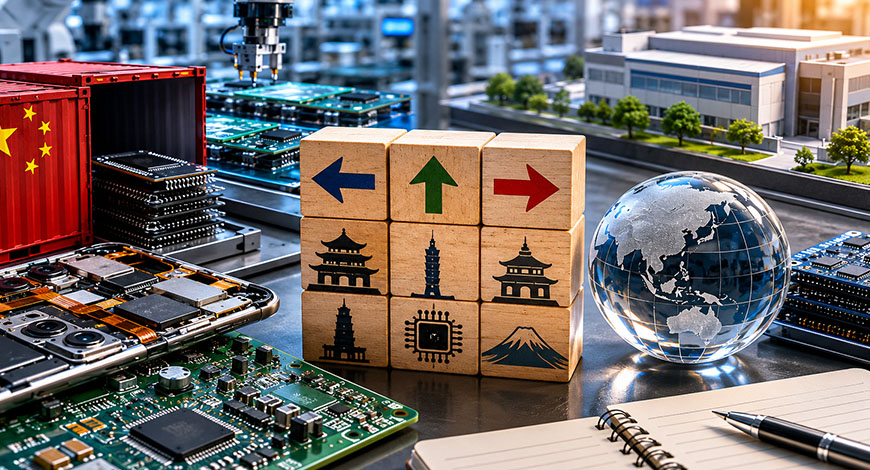
Since March, companies including Dixon Technologies, Amber Enterprises, PG Electroplast, Epack Durable and Syrma SGS Technology have signed or operationalised at least eight partnerships with manufacturers from South Korea, Taiwan and Japan, not China, to build electronic parts and finished products. Dixon is finalising a joint venture with Taiwan’s Inventec Corp for laptops, servers and desktops, and separately signed a binding term sheet with Taiwan’s Gemtek Technology for telecom equipment. Syrma SGS has partnered with Japan’s Kaga Electronics on a new plant serving Japanese customers, Epack Durable is operationalising a joint venture with South Korea’s Bumjin Electronics for smart audio devices, and Amber Enterprises broke ground last week on a circuit-board plant with Korea Circuit Co. Dixon managing director Atul Lall has described the company’s growth as coming through partnerships across the globe, framing the strategy as a way to derisk and cut its complete dependence on China.
The reform’s own test case is still pending
The clearest illustration of why manufacturers are not simply waiting for Press Note 3 to work is Dixon’s own proposed joint venture with Chinese smartphone maker Vivo, a deal that has been stuck awaiting government approval for more than a year, spanning both the old restrictive regime and the eased one. Reports in late June suggested the venture, in which Dixon would hold a 51 percent stake, had cleared an inter-ministerial panel and was nearing final sign-off, with a separate Enforcement Directorate probe into Vivo India under money-laundering law cited as one factor behind the prolonged scrutiny. That a flagship case of exactly the kind of deal Press Note 3 was relaxed to unblock is still not fully closed, even as the fast-track clock was meant to start ticking, is precisely the signal domestic manufacturers appear to be reading: paper reform and deal-level reality are moving at different speeds.
When going it alone beats waiting on Beijing too
The friction cuts both ways across the border. PG Electroplast, India’s leading contract manufacturer of ACs and televisions, is building a more than Rs 300 crore AC compressor plant entirely on its own after a proposed technical alliance with China’s Highly Group stayed stalled for over six quarters awaiting approval from Chinese, not Indian, authorities. Machinery installation begins in August at a facility with initial annual capacity of two million compressor units. MD (finance) Vishal Gupta has told analysts the company has now acquired the capability to manufacture compressors on its own, enabling it to offer cost-competitive and energy-efficient products, without naming the now-defunct Chinese partner. The episode is a reminder that the bottleneck delaying China-linked electronics deals isn’t only Indian security clearance, it runs through Beijing’s own approval processes too, leaving Indian firms with no fast track to lean on from either capital.
Hedging, not decoupling
None of this amounts to Indian manufacturers abandoning Chinese technology or cost advantages, which industry executives say remain unmatched in several categories. Ajay DD Singhania, managing director at Epack Durable, has noted that it isn’t possible to find a non-Chinese partner in every segment or match Chinese production costs, adding that Chinese companies remain the partner of choice in home appliances and mobile phones even as non-Chinese partnerships become viable in semiconductors and certain components. That distinction matters: the current wave of Korean, Taiwanese and Japanese tie-ups is concentrated in components, PCBs and telecom hardware, segments where alternatives exist, while China retains its edge in the high-volume categories, like appliances and smartphones, where India’s manufacturers have the least room to hedge.
That split suggests Press Note 3’s relaxation may end up shaping which deals get signed rather than how many. For components and capital goods, Indian manufacturers now have both an eased regulatory path to Chinese capital and workable non-Chinese alternatives, and appear to be pricing in the latter’s certainty over the former’s speed. For the categories where no real substitute exists, the Dixon-Vivo case suggests the wait for Chinese partnerships to clear, fast-track or not, is set to continue.
CT Bureau







You must be logged in to post a comment Login