
Convergence India 2026
Convergence India Expo 2026: Experts Outline AI-Driven Urban Roadmap for Viksit Bharat 2047
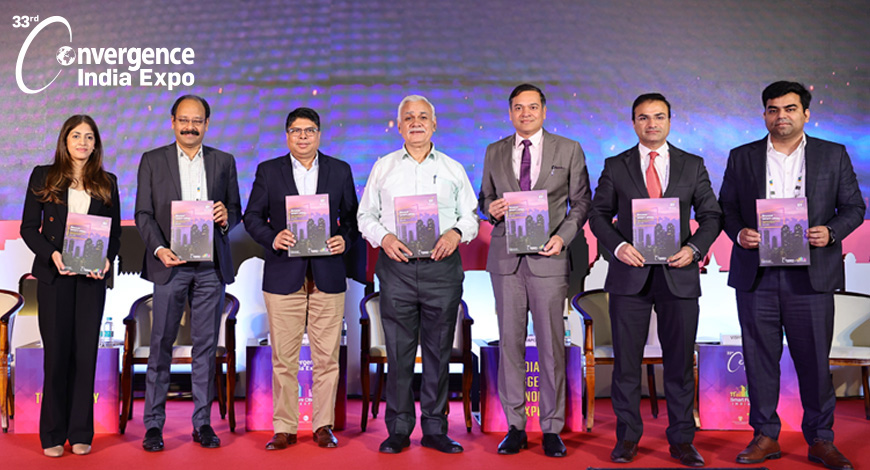
At the 33rd Convergence India Expo 2026, a compelling panel discussion titled “Viksit Bharat 2047: How AI-Powered Cities Will Drive India’s Next Growth Story” brought together policymakers, infrastructure leaders, and technology experts to examine how artificial intelligence can redefine India’s urban future. Held at the Convergence Stage, the session was moderated by Ashutosh Rai, Director at EY, and featured distinguished speakers from government and industry.
Cities as Engines of Growth in the AI Era
Setting the tone for the discussion, Durga Shanker Mishra, IAS (Retd.), Former Chief Secretary of Uttar Pradesh emphasised the critical role cities play in India’s economic trajectory. “Cities are the engines of economic growth,” he noted, highlighting how urban centres enable migration, productivity, and innovation.
Mishra pointed to a massive demographic transition underway. India’s urban population, currently estimated at 52-53 crore, is expected to exceed 90 crore by 2051. This implies an addition of nearly 400 million people to urban areas, an unprecedented shift that presents both a challenge and an opportunity. According to him, the key lies in leveraging this urban expansion to accelerate economic growth and move closer to the vision of Viksit Bharat 2047.
He further underscored that the emergence of artificial intelligence significantly enhances this opportunity. AI, he explained, is strengthening the digital ecosystem and has the potential to transform every aspect of urban management, from planning and approvals to transport, logistics, and service delivery. “AI-driven cities can become far more efficient, predictive, and responsive,” he stated.
AI as an Enabler, Not a Substitute for Governance
While acknowledging AI’s transformative potential, Mishra cautioned against over-reliance on technology alone. “AI is only an instrument. It is a powerful digital tool, but not a solution in itself,” he remarked. Effective governance, institutional capacity, and strong leadership remain indispensable.
He stressed that municipal bodies and city administrators must play a proactive role in execution, as AI can only enable and facilitate outcomes. This becomes even more critical as cities face mounting pressures from climate change. Mishra highlighted the role AI can play in addressing urban challenges such as sanitation, water management, drainage, healthcare, and climate resilience. Predictive analytics, for instance, could help cities better prepare for flooding and heatwaves, issues that are expected to intensify in the coming years.
From Reactive to Proactive Governance
Rahul Kapoor, Executive Director, Finance, Ministry of Railways, Government of India, elaborated on the governance dimension, emphasising the need for a paradigm shift. “As we move into the decade of AI, the real shift is from reactive governance to proactive governance,” he said.
Kapoor offered an insightful analogy to describe the importance of data in this transformation. “Data is often called the new gold, but I believe it is more like oil, because oil flows, while gold remains static,” he explained. For data to generate real value, it must move seamlessly across systems, enabling integrated decision-making and real-time responses.
This perspective underscores the importance of data-sharing frameworks and interoperable digital infrastructure in building AI-powered cities.
India’s Emerging AI City Landscape
Adding a practical dimension to the discussion, Susanth Kurunthil, CEO of Infoparks Kerala, shared updates on India’s emerging AI city initiatives. He revealed that three AI cities, Lucknow, Bengaluru, and Kochi, have already been approved.
Kurunthil is leading the Kochi AI city project, envisioned as a 500-acre integrated development within the third phase of InfoPark. “This is not just another urban project,” he said. “It is being conceived as a fully integrated AI-native city from the ground up.”
The project aims to embed AI into the very fabric of urban design, creating a seamless ecosystem that integrates technology, infrastructure, and human-centric services. Such initiatives signal a shift from retrofitting existing cities with smart technologies to building AI-first urban environments.
Digital Twins and Data-Driven Urban Planning
Sovan Mandal, CEO of Valocity India and the Middle East, highlighted the transformative potential of digital twins, virtual replicas of physical environments. “When you have robust digital data, you can simulate entire urban environments,” he said.
Drawing on global examples, Mandal pointed out that cities like Singapore have successfully implemented digital twin technologies, while Barcelona uses them for flood management. These systems enable authorities to model scenarios, predict outcomes, and optimise urban planning decisions.
He also noted that advanced data analytics can go beyond infrastructure to enhance the quality of life. In some countries, for instance, utility usage patterns are analysed to monitor the well-being of ageing populations. Such applications demonstrate how data-driven insights can support both governance and social welfare.
Integrating AI into Industrial and Urban Infrastructure
Vishnu Sharma Dadhich, DGM and Head of Corporate Affairs & Marketing at NICDC, brought a broader perspective by reflecting on the evolution of technology. “I have witnessed three major transformations: the computer age, the rise of the internet, and now the emergence of AI,” he said, describing the current moment as a defining phase in human progress.
Recognising AI’s potential, he noted that organisations like NICDC have already begun integrating digitalisation and AI-driven approaches into infrastructure projects from the early stages. This forward-looking approach ensures that developments are aligned with both domestic and global demand.
Dadhich also highlighted the importance of creating integrated urban ecosystems. Plans are underway to develop plug-and-play, walk-to-work infrastructure models that combine commercial, residential, and social amenities. Such models not only enhance efficiency but also support sustainable industrial growth.
Toward a Sustainable and Intelligent Urban Future
Following the session, a knowledge report was officially unveiled by Chandrika Behl, Managing Director, Exhibitions India Group, along with the Moderator and the prominent speakers.
As India moves toward its centenary of independence in 2047, AI-powered cities are poised to play a pivotal role in shaping the nation’s growth story. By harnessing data, fostering innovation, and strengthening institutions, India has the opportunity to not only meet the challenges of rapid urbanisation but also emerge as a global leader in next-generation urban development.
About Convergence India Expo 2026
The Convergence India Expo continues to act as a vital platform where policymakers, innovators, and industry leaders converge to drive discussions on emerging technologies. Hosted at Bharat Mandapam in New Delhi, the event remains a key hub for dialogue on India’s digital transformation and innovation ecosystem, with the nsext edition scheduled for March 23 to 25, 2027.
CT Bureau







You must be logged in to post a comment Login