
Headlines of the Day
Beyond assembly: What the new mobile and chip schemes really test
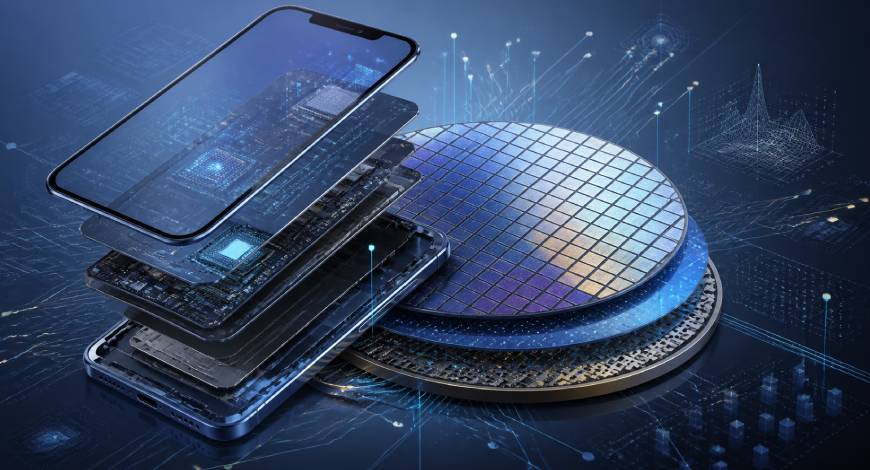
The Cabinet’s back-to-back approval of the ₹62,500 crore Mobile Phone Manufacturing Scheme and the ₹1.27 trillion India Semiconductor Mission 2.0 is best read not as a standalone industrial announcement but as a course correction. Phase one of the PLI programme did what it was designed to do: it turned India into the world’s second-largest mobile phone producer by volume and made smartphones a genuine export line item. What it did not do, and was never really structured to do, was change where the value in that supply chain sits. Final assembly is the most visible and most easily incentivised part of electronics manufacturing, but it is also the part with the thinnest margins. The real money in a smartphone lives in the chipset, the display module, the camera stack, the battery management system and the intellectual property layered on top of all of it, and on that count India has remained a taker rather than a maker.
The design of MPMS is a tacit admission of that gap. Structuring incentives in three distinct tiers, a base 2.25-5 per cent on eligible sales, an additional layer of up to 1.5 per cent tied specifically to domestic sourcing of components and subassemblies, and a further 3 per cent for investment in design and R&D, is a meaningfully different instrument from PLI 1.0, which rewarded volume more or less indiscriminately. It nudges manufacturers toward backward integration rather than simply rewarding them for assembling more units with the same imported parts. That is the right instinct, and it reflects a lesson the government appears to have absorbed from its own trade data: the electronics trade deficit widened to $68.17 billion in 2025-26, driven overwhelmingly by imports of semiconductors, memory chips and other high-value inputs. Producing more phones while importing more of what goes into them is not import substitution; it is import substitution’s opposite, dressed up in export statistics.
ISM 2.0 is the necessary complement to that logic, and arguably the harder bet of the two. Where the first phase of the semiconductor mission was largely about getting fabrication and packaging projects off the ground and proving India could attract capital into the space at all, the second phase widens the aperture considerably, covering design, advanced packaging, manufacturing equipment, specialty chemicals and materials, R&D and domestic IP. That breadth is deliberate and defensible: a fab without a domestic design ecosystem, a reliable materials supply chain and a talent pipeline behind it is a stranded asset waiting to happen. But breadth also multiplies execution risk. Semiconductor manufacturing is one of the least forgiving industries in the world for policy inconsistency, water and power reliability, and approval timelines, and India’s track record on all three has been mixed at best. Fiscal incentives can lower the cost of entry; they cannot manufacture the ecosystem discipline that Taiwan, South Korea and increasingly Vietnam have spent decades building.
The implications worth watching are less about the headline numbers, the ₹39 trillion cumulative production target is easy to announce and hard to independently verify five years out, and more about three structural questions. First, whether the component-sourcing incentive actually shifts sourcing decisions or simply gets absorbed as a margin top-up by companies that keep importing anyway, since 1.5 per cent is a modest lever against entrenched supply-chain relationships and cost gaps with China and Vietnam. Second, whether ISM 2.0’s broader mandate translates into an actual domestic base of fabless design houses and specialty-chemical suppliers, or whether it remains concentrated in a handful of large packaging and assembly projects that photograph well but don’t move India up the value chain. Third, and most tellingly, whether policy stays the course long enough for any of this to compound, given that component ecosystems take longer than one product cycle or one election cycle to mature.
The government’s parallel moves, clearing the Dixon-Vivo joint venture and trimming import duties on select components, are a useful signal here, and arguably an underappreciated one. They suggest an implicit recognition that self-reliance built through isolation is a slower and often illusory path, and that every major electronics exporter, from China in the 1990s to Vietnam more recently, climbed the value chain by first embedding itself in foreign capital and supplier networks before localising. That is a more pragmatic reading of self-reliance than the rhetoric around these schemes sometimes suggests, and it is probably the correct one. The honest scorecard for MPMS and ISM 2.0 will not be production volumes or even export numbers; it will be whether, five years from now, a meaningfully larger share of the value inside an Indian-made phone or chip is actually Indian.
CT Bureau












You must be logged in to post a comment Login