
Headlines of the Day
Jefferies flags Dixon, Kaynes, Syrma SGS, Uno Minda after MPMS approval
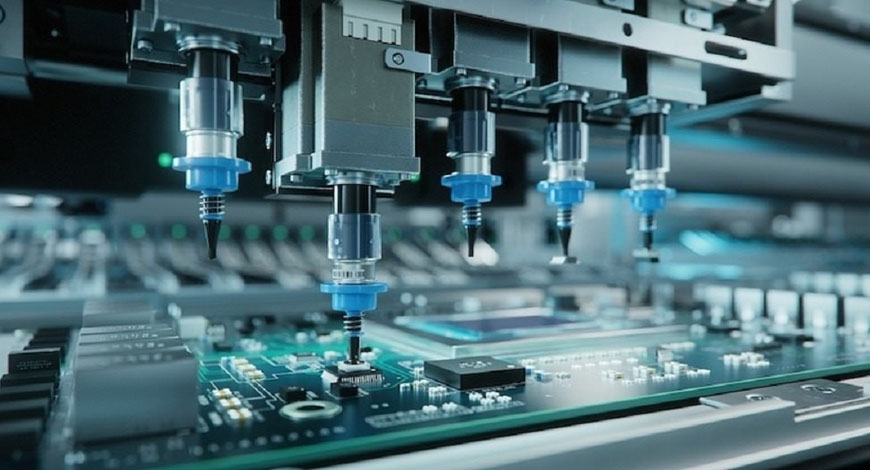
The Centre’s new ₹62,500-crore incentive scheme lifted shares of listed electronics manufacturing services companies.
Dixon Technologies (India) Ltd, Syrma SGS Technology Ltd, Kaynes Technology India Ltd and Amber Enterprises India Ltd—four of India’s largest listed EMS firms—gained 6.1%, 1.5%, 3% and 2%, respectively, even as the benchmark Nifty 50 was largely flat.
While Dixon, which makes smartphones for Vivo, and Amber, which signed an agreement with Chinese handset maker Oppo in June, are directly involved in mobile phone manufacturing, Syrma and Kaynes participate in the ministry of electronics and information technology’s (MeitY) Electronics Components Manufacturing Scheme (ECMS).
Though details of the Mobile Phone Manufacturing Scheme (MPMS), which replaces the production-linked incentive (PLI) scheme for large-scale electronics manufacturing that expired on 31 March, are still awaited, the announcement comes as a shot in the arm for the slowing industry.
The new scheme, which will run from FY27 to FY31, will offer manufacturers incentives of 2.25-5% on eligible sales of locally made mobile phones, with an additional incentive of up to 1.5% for sourcing key components and sub-assemblies domestically. Separately, a company can claim 3% of its capex for creating an Indian mobile brand.
The government expects the scheme to drive cumulative production of ₹39 trillion over five years.
Margin boost
Stakeholders said the move to incentivize domestic value addition would sharply benefit most EMS firms, including the privately held Tata Electronics.
“Additional incentives for investing in moving away from a China-linked component supply chain to more sourcing from vendors within India were strongly requested by the industry. With the scheme now in place, there is clearly a strong tailwind for the sector,” said Harshit Kapadia, vice-president at brokerage firm Elara Capital.
Analysts Vishal Goel and Sandesh Shetty at brokerage firm HSBC Global Investment Research concurred in a note to investors that the scheme “hugely benefits Dixon, alleviating our concerns on margin erosion and customer retention”. Dixon is the country’s largest listed electronics maker.
“Under the old PLI scheme, Dixon used to pass on the ‘lion’s share’ of incentives (3.3-3.4% out of 4% it received) to customers. We had therefore reduced our margin estimates for FY27 compared to FY26, and had assumed margin expansion from FY28 through backward integration into component manufacturing,” the note said, adding that the brokerage expects margins to be supported by the MPMS.
Mint’s queries emailed to Saurabh Gupta, group chief financial officer of Dixon, remained unanswered.
Elara’s Kapadia added that the expectation of a sectoral tailwind is in anticipation of greater profitability—something that EMS firms have not managed to achieve as yet.
Ajai Chowdhry, co-founder of HCL Enterprise and founder of industry consultancy body Epic Foundation, added that the early contours of the policy “appear mature, and show that the country’s electronics ecosystem has climbed up the global value chain over the past years”.
The scheme has not been notified, with Union IT minister Ashwini Vaishnaw offering a “15 to 20 days” timeline for its details.
Mint’s queries emailed to Kaynes, Amber, Tata Electronics, Foxconn and Bhagwati Products remained unanswered. Syrma declined to comment, citing its upcoming quarterly results.
Localization play
The scheme comes as the country has emerged as the world’s second-largest mobile phone manufacturer by volume. According to MeitY, 99.2% of phones sold in the country are now assembled locally, a sharp turnaround from its dependence on imports a decade ago.
However, New Delhi’s plan to revive homegrown mobile brands is still a work in progress, even though the Centre announced a tentative 3% incentive for it on Wednesday, Amitesh Sinha, additional secretary at the ministry of electronics and information technology and chief executive of the India Semiconductor Mission, said.
“The latter is where the true complexity of the scheme lies, but is also one of the biggest opportunities that an Indian company can take. We’re constantly speaking with the industry and gauging what they need,” Sinha said, adding that this will not be a repeat of the past decade, when brands imported components from China and assembled devices in India.
A decade and a half ago, homegrown brands such as Micromax and Lava lost ground to Chinese rivals, including Xiaomi, Vivo and Oppo. In 2012, India did not have a local assembly or components ecosystem, requiring all homegrown brands to source designs and components from China and assemble devices here in captive facilities.
“We won’t be making such a mistake this time, and the effort behind the MPMS today is to create a supply chain independent of heavy reliance on China,” Sinha said.
Chowdhry agreed, saying the “domestic brand policy is necessary to cement India’s stature as one of the world’s largest electronics economies”.
“India is one of the biggest markets where over 140 million phones are sold every year. If you look at China’s success, you see that it too leveraged its stature to create homegrown brands that then exported to the world,” he said.
The three policies—ECMS, Semicon 2.0 and MPMS—complement one another and, for the first time, provide a roadmap to localize the entire electronics value chain amid rising geopolitical concerns, he added. LiveMint











You must be logged in to post a comment Login