
International Circuit
South Korea’s Gwangju military airport selected for semiconductor complex
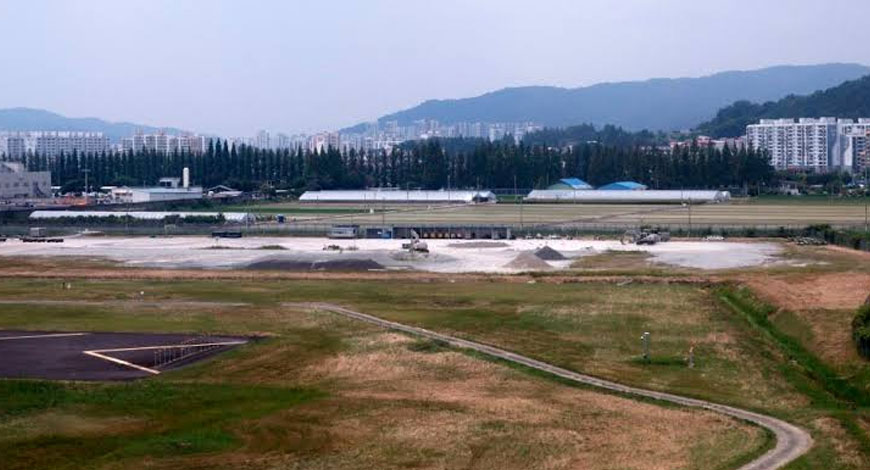
The Gwangju military airport site selected by Cheong Wa Dae on the 6th is state-owned land, which is advantageous as there are virtually no land compensation issues. It is located within a straight-line distance of 2 km from Gwangju Songjeong Station, served by KTX, and is also close to the Honam Expressway. However, a major challenge is the need to relocate the military airport to Muan Airport in South Jeolla Province, which requires the consent of Muan County residents.
Samsung Electronics and SK Hynix task forces inspected the Advanced District 3 and the military airport site, among others, reviewing factors such as site scale, water supply, and electricity supply conditions. After discussions with the government, it was reported that the Gwangju military airport was selected. Presidential Chief of Staff Kang Hoon-sik stated during a Cheong Wa Dae briefing that day, “The companies proposed that the Gwangju military airport is the most suitable site among the Honam region’s candidate locations,” and added, “We have decided to establish a semiconductor complex in the Honam region at the Gwangju military airport site.”
The site’s biggest advantage is that it is a large, already leveled area, which reduces the time required for site development. The military airport relocation site in Gwangju’s Gwangsan District, Jeonnam-Gwangju, spans 8.2 million square meters (approximately 2.5 million pyeong), roughly three times the size of Yeouido. For semiconductor factories, where precision equipment like exposure and metrology devices operate at the nanometer scale, ground stability is crucial. Sloped or topographically complex sites require more time and cost for ground improvement and foundation work. The proximity to Yongyeon Water Treatment Plant near Mount Mudeung, which can provide highly purified water, is also advantageous for securing water resources.
A source from the semiconductor industry explained, “Even the discovery of cultural assets during factory construction can delay project schedules, but this site, being already developed, has relatively fewer such risks,” and added, “If power and water supply can be secured without issues, this site allows for relatively swift navigation through cumbersome administrative procedures.”
The site also has the infrastructure to train over 2,000 people annually in AI and semiconductor specialties, centered around the Gwangju Institute of Science and Technology (GIST), Chonnam National University, Chosun University, the Korea National University of Energy and Power, Jeonbuk National University, and local Meister high schools.
Airport relocation expected to take 10 years, muan opposition also a variable
The issue lies in the relocation of the Gwangju military airport. Since the site itself is state-owned, procedures like land compensation or resident relocation are virtually unnecessary. Although the process of relocating to Muan International Airport is already underway, Muan County opposes it, citing noise pollution from fighter jets. A six-party meeting of the military airport site selection committee, scheduled for June 30 at the Ministry of National Defense, was canceled due to the absence of Muan County Mayor Kim San.
As early as the end of this month, the site selection committee may reconvene to finalize Muan Airport as the relocation site. However, subsequent steps require a resident vote, and Muan County Mayor must apply to host the military airport. The referendum passes if more than one-third of eligible voters participate and a majority of valid votes approve. Mayor Kim stated, “The focus is hastily selecting a relocation site while neglecting the implementation of our three key demands.” Muan County’s three demands are: the prior relocation of Gwangju’s civilian airport to Muan International Airport, support of 1 trillion Korean won from Jeonnam-Gwangju Special Self-Governing Province and the government, and the provision of groundbreaking national incentives.
The duration of the military airport relocation is also a concern. In December last year, when the government, Gwangju, South Jeolla, and Muan agreed to relocate the Gwangju military airport to Muan, a Gwangju city official stated, “It will take about 10 years to develop the relocation site in Muan.” The Ministry of National Defense noted, “No specific relocation timeline has been set,” but added, “Based on current assessments, site selection is expected to be completed within 2026, with site development and military airport construction finishing around the early to mid-2030s.” Jeonnam-Gwangju Special Self-Governing Province Mayor Min Hyung-bae estimated, “If construction is accelerated, the military airport could be built in five years at a cost of 8–9 trillion Korean won.”
The project to relocate the Maseok-dong and Geumho-dong ammunition depots in Seo-gu, Jeonnam-Gwangju, adjacent to the Gwangju military airport, will inevitably be halted once the semiconductor complex is developed. The area, designated as a military facility protection zone due to the ammunition depots, has seen persistent resident demands for relocation. The project, initiated in 2005, had spent 268.1 billion Korean won on land acquisition and leveling by last year. A Ministry of National Defense official stated, “Even if the site is used for other purposes like the semiconductor complex instead of an ammunition depot, its land value and infrastructure investments will be recognized, so the budget was not wasted.”
Another variable is the presence of the U.S. Contingency Operating Base (COB) at the current Gwangju military airport. The COB is a base where the U.S. military maintains only a small administrative staff during peacetime but deploys assets and supplies during wartime. If the military airport relocates to Muan Airport, the COB will also move there. In the past, when relocation was proposed, Muan County opposed it, arguing, “Muan cannot become a forward base against China.” The Chosun









You must be logged in to post a comment Login