
Company News
Samsung, SK Group plan up to 900T won AI chip cluster in Gwangju
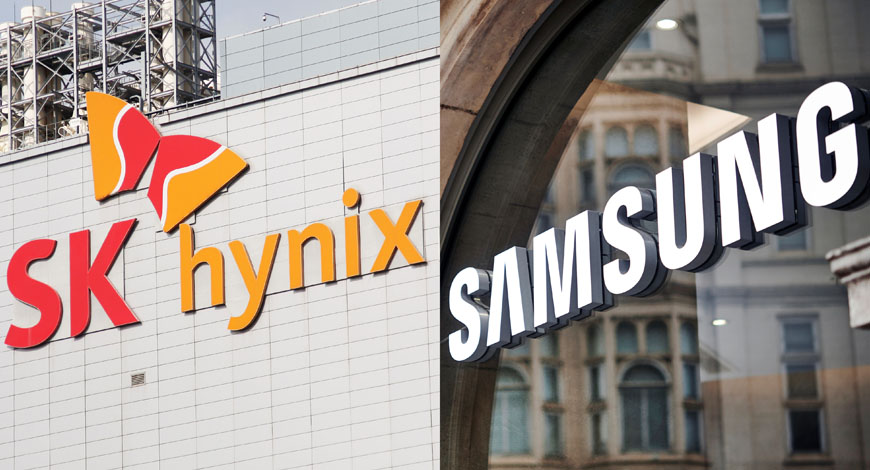
Samsung and SK Group are investing an astronomical sum of 700 trillion to 900 trillion won to build a new semiconductor cluster in Gwangju, aiming to strengthen their dominance in artificial intelligence (AI) chips while responding to the global expansion of AI infrastructure investment. As global big tech firms compete to build large-scale AI data centers, demand for AI memory chips, a core component, is exploding.
The industry estimates that major big tech firms, including Microsoft, Alphabet, Meta and Amazon, will invest more than 1 trillion dollars (about 1,538 trillion won) in AI data centers by next year. As the investment war to seize AI dominance intensifies, expanding semiconductor supply has become unavoidable.
Indeed, the pursuit by Micron, the third-largest memory maker backed by full support from the U.S. government, is fierce. Micron, which holds a monthly wafer production capacity of 300,000 units, plans to build two new fabs in Idaho, where its headquarters are located, by 2030 to add about 100,000 units of production capacity. In addition, it is building four fabs in New York state and is also expanding Taiwan PSMC’s Tongluo P5 plant and its Hiroshima fab in Japan.
Accordingly, Samsung Electronics (005930.KS) and SK hynix (000660.KS) have decided to complete the semiconductor clusters they are each building in Yongin seven and 12 years ahead of schedule, respectively, and to build a new semiconductor cluster in the southwest region centered on Gwangju. Samsung Electronics and SK hynix have requested full support from the government, as the Yongin semiconductor cluster must be completed quickly for them to build the southwest semiconductor cluster, which serves as a follow-up investment.
The government also plans to provide one-stop, prompt support — covering not only Yongin fab construction and power and water supply but also infrastructure for the southwest semiconductor cluster — given that Samsung Electronics and SK hynix have decided to build a new semiconductor cluster in Gwangju for balanced regional development.
Samsung Electronics and SK hynix plan to build six and four fabs, respectively, in the Yongin semiconductor cluster to secure an additional monthly production capacity of around 300,000 units. The two companies, assessing that demand for AI industry infrastructure is still in its early stages, are said to have selected additional production bases early. Samsung Electronics plans to invest 300 trillion to 400 trillion won and SK hynix 400 trillion to 500 trillion won in building the southwest semiconductor cluster, reflecting the fact that SK hynix’s completion of the Yongin semiconductor cluster is six to seven years ahead of Samsung Electronics, according to sources.
SK, Samsung and Naver also plan to announce a project to invest about 400 trillion won to build around five 1-gigawatt (GW) AI data centers in Jeonnam, Chungcheong, Yeongnam and Gangwon. Through investment on a scale comparable to OpenAI’s Stargate project, the plan is to create a foundation for domestic companies to develop their own AI foundation models without being dependent on the data centers of global big tech firms.
Regarding this, Ryu Young-sang, chairman of the AI committee at SK SUPEX Council, stressed at a briefing held in California, U.S., on the 26th, “Cooperating with the U.S. and other countries is fundamental, but I think we have no future unless we achieve self-reliance.”
In line with the Gwangju semiconductor cluster investment, key Samsung Group affiliates are also making record-level investments in the Chungcheong and Yeongnam regions to drive regional economic development. Samsung Display is known to be planning large-scale investments of up to 100 trillion won over the next 10 years, centered on its Asan and Cheonan campuses, which serve as production hubs for organic light-emitting diodes (OLED) and next-generation displays. “Samsung Display’s additional investment plans related to next-generation OLED production are included in this announcement,” an industry official said.
Samsung Display’s strategy is to build next-generation display production facilities in the Chungcheong region to respond to demand for various panels that will increase with the expansion of the AI industry, including mobility, smart glasses, home appliances and humanoid robots.
Samsung Electro-Mechanics also plans to invest trillions of won in Sejong to build an AI chip substrate production plant. Samsung Electro-Mechanics is known to be planning to build a new AI substrate production plant — for which orders from global big tech firms have recently surged — on idle land at its Sejong site. Samsung SDI’s (006400.KS) Cheonan site is also expected to expand its production capacity for small batteries and automotive batteries in line with the expansion of next-generation mobility and physical AI markets.
Large-scale investments to build a foundation for future industries are also being made in the Yeongnam region. Samsung SDI is known to be planning facility investments at its Ulsan site to expand production of energy storage systems (ESS), demand for which is rapidly increasing with the spread of AI infrastructure. Samsung Electro-Mechanics is understood to be planning to announce expansions of both its multilayer ceramic capacitor (MLCC) and semiconductor substrate plants — the two pillars of its Busan site.
In Incheon, Samsung Biologics is expected to pursue investments to expand research and development (R&D) and production lines, in line with Chairman Jay Y. Lee’s vision of growing the bio industry into a “second semiconductor.”
Hyundai Motor Group is also set to unveil large-scale investment plans related to physical AI. Hyundai Motor is pursuing investment to develop Saemangeum in North Jeolla Province as a hub for future mobility and physical AI.
In addition, at LG (003550.KS) Group, which is making physical AI and AI infrastructure new growth engines and expanding its cooperation with Nvidia, there is talk that LG Innotek may make an AI chip substrate investment at its Gumi site in North Gyeongsang Province. Seoul Economic Daily







You must be logged in to post a comment Login