
Headlines of the Day
States make a unified pitch at NITI Aayog Governing Council
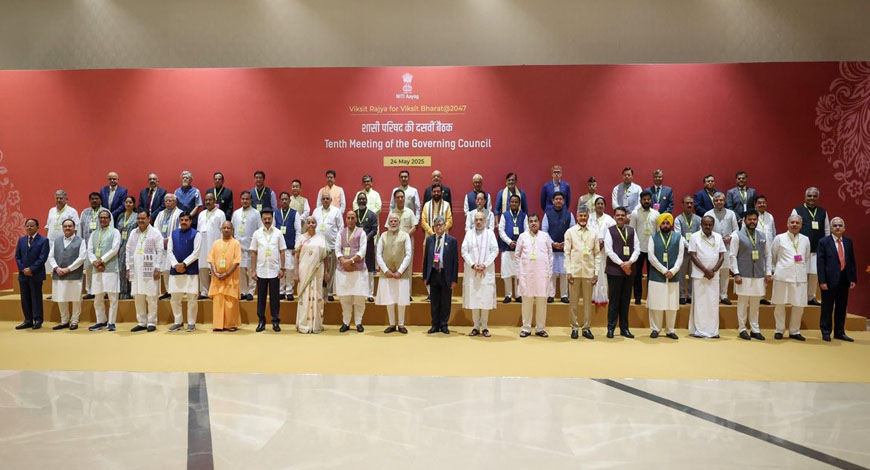
From semiconductors to AI hubs, the 11th meeting revealed a country whose states are racing to claim a stake in the next industrial wave, but want New Delhi to help foot the bill
At the 11th meeting of the NITI Aayog Governing Council, Prime Minister Narendra Modi presided over what may have been the most tech-forward gathering of state chief ministers in recent memory. Beneath the headline theme of “inclusive human development,” a pointed sub-narrative emerged: states across the political spectrum are converging on semiconductors, artificial intelligence, and digital infrastructure as the engines of their next-decade growth, and they want the Centre to back the bet.
The semiconductor scramble
The push around semiconductors was striking both for its breadth and its urgency. Haryana Chief Minister Nayab Singh Saini made perhaps the most direct pitch, seeking “a special incentive package from the Centre to develop the state into a semiconductor, data centre, and electronics manufacturing hub.” The ask underscores how far the semiconductor conversation has moved, from a niche policy discussion a few years ago to a mainstream political priority in a state better known for agriculture and automotive manufacturing.
Chhattisgarh CM Vishnu Deo Sai, meanwhile, flagged that two semiconductor manufacturing units are already being established in the state, framing it alongside AI as part of a broader effort to attract investments in “emerging sectors.” That a landlocked, historically resource-economy state like Chhattisgarh is now courting chip fabs speaks to how thoroughly India’s semiconductor ambitions have diffused beyond the obvious coastal and metro clusters.
The demand for central support for semiconductor projects was also folded into the sweeping infrastructure proposals made by Telangana CM Revanth Reddy, who proposed an “M-6 Task Force” under the Prime Minister’s Office for accelerated development of Delhi, Mumbai, Kolkata, Chennai, Hyderabad, and Bengaluru, with a ₹6 trillion fund earmarked across the six cities. Hyderabad and Bengaluru, two of the six, are already India’s most significant tech and chip-design hubs, making the ask as much about technology infrastructure as physical infrastructure.
AI moves from aspiration to action item
Artificial intelligence featured not as a distant ambition but as a concrete policy lever in multiple state presentations. Chhattisgarh’s road map for Bastar district explicitly identified AI as a sector to attract investment into, while Karnataka CM D K Shivakumar,
representing the state that houses Bengaluru, India’s de facto AI capital, made the case for central partnership in infrastructure upgradation, noting that 40 per cent of the city’s residents are migrants drawn by the tech economy.
Shivakumar’s proposal for a centralised job portal where industries share skill requirements for the next three years carries unmistakable AI-era logic: as the nature of work shifts rapidly, states are recognising that talent pipelines must be planned and coordinated at scale, not left to market signals alone. Whether the Centre acts on this or not, the framing itself signals a maturation in how state governments are thinking about AI’s labour market implications.
Maharashtra CM Devendra Fadnavis, who outlined his state’s road map to a $5 trillion economy by 2047, has consistently positioned Maharashtra, home to Mumbai’s financial infrastructure and Pune’s tech corridor, as central to India’s AI and data centre ambitions. The meeting offered an implicit reminder that the race between Maharashtra and Karnataka for AI and cloud infrastructure supremacy is playing out at the highest levels of federal policymaking.
Telecom and connectivity: The unspoken backbone
Telecom did not grab headlines at the meeting, but it ran through the subtext of several state demands. Karnataka’s case for infrastructure investment in Bengaluru is inseparable from the connectivity and data-centre backbone that India’s AI economy depends on. Punjab CM Bhagwant Singh Mann’s push for border-area development, noting that over 2,000 villages near the border remain poorly covered under development schemes, implicitly raises the question of connectivity: areas left behind in broadband and telecom rollout cannot meaningfully participate in a digital economy.
Andhra Pradesh CM N Chandrababu Naidu, whose state has been aggressive in positioning itself as a technology-friendly destination through its Amaravati rebuild and investment attraction drive, with commitments exceeding ₹23 trillion, has been among the most vocal advocates for enabling infrastructure. His caution against “unsustainable incentive-based competition” between states for investment is a pointed message in a landscape where states are increasingly willing to offer fiscal sweeteners to land semiconductor and data centre projects.
A policy moment that needs a policy response
What Thursday’s meeting made clear is that states are no longer simply requesting roads and railways from New Delhi. They are asking for a nationally coordinated industrial policy in sectors with complex supply chains, long capital cycles, and regulatory coherence across central ministries, whether it is chip fabs seeking land, water, and power guarantees, or AI companies needing reliable, high-bandwidth connectivity and clarity on data governance.
The diversity of states making these asks, from Haryana to Chhattisgarh to Karnataka to Andhra Pradesh, suggests that the political will is broadly present. What remains to be seen is whether the Center will respond with equivalent ambition: targeted financial instruments, a rationalized approvals framework, and the inter-ministerial coordination that will actually be required to turn India’s semiconductor and AI aspirations into factory floors and data centers.
The 11th Governing Council meeting may be remembered less for what was decided than for what it revealed, that India’s states have internalised the logic of the technology economy, and are now, collectively, knocking on New Delhi’s door.
CT Bureau







You must be logged in to post a comment Login