
CT’s Take
The data center that’s already outdated before it opens
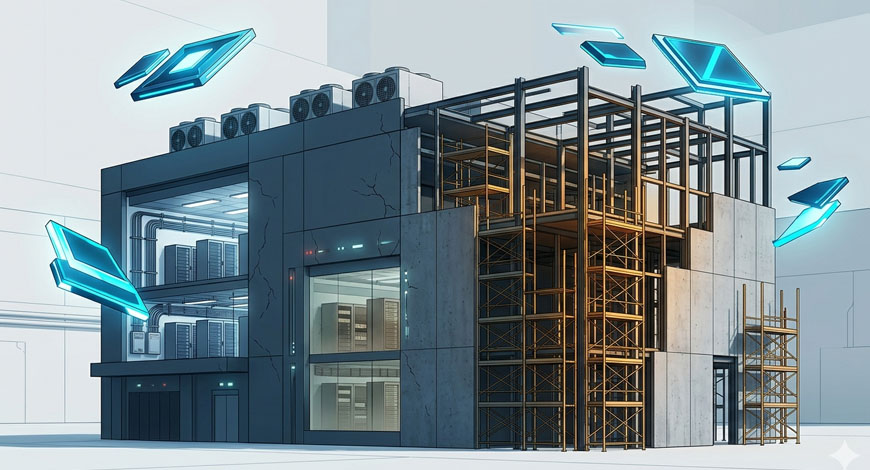
Nobody in the industry likes to say out loud. It is the paradox of permanent infrastructure: committing decades of capital to buildings designed around hardware that becomes obsolete in under two years.
Somewhere right now, a construction crew is pouring concrete for a data center that will be, in a meaningful sense, behind schedule before it’s finished.
Not because of project mismanagement. Not because of supply chain delays. But because the hardware the building was designed around, the GPUs specced, the power loads calculated, the cooling systems engineered, will have been superseded by the time the facility takes its first live workload. Nvidia moves on an 18-to-24-month cycle. A traditional data center build takes up to five years. The math has never worked, and for a long time the industry absorbed that gap through a combination of long depreciation schedules and the fact that compute demand, while growing, wasn’t growing fast enough to make the obsolescence sting immediately.
That era is over.
The acceleration that changed everything
AI didn’t just increase demand for compute. It compressed the consequences of hardware generations in a way that exposes the fundamental awkwardness of building permanent structures around ephemeral technology.
Consider what one GPU generation transition actually means in physical terms. A fully configured NVIDIA DGX H100 system draws a maximum of 10.2 kW. Its successor, the Blackwell B200 platform, can pull between 120 kW and 135 kW per single rack at full scale. That’s not an incremental upgrade requiring a firmware patch and a slightly bigger power bill. That’s a twelve-fold increase in thermal and electrical demand, embedded in a footprint that looks physically similar from the outside. Facilities engineered for one generation cannot simply absorb the next.
Meanwhile, the AFCOM State of the Data Center report recorded a 69% year-over-year jump in average rack density, to 27 kW per rack, the largest single-year increase in the report’s ten-year history. “A 69% year-over-year jump in average rack density to 27 kW per rack is not a rounding error; it is a step-function change,” noted Bill Kleyman, programme chair for Data Center World and co-author of the report. Nearly 70% of respondents expect density to climb further over the next 12 to 36 months.
The building isn’t just chasing the hardware. It’s losing ground every quarter.
Why modular is actually a philosophical shift
The industry’s response, a rapid pivot toward prefabricated modular data centers, is being framed primarily as a speed story. Standardised components. Faster builds. Eighteen-to-twenty-four months from groundbreaking to operations instead of five years. All of that is true, and it matters enormously in a market that McKinsey & Company projects will require 156 GW of AI-related capacity by 2030.
But the more interesting thing modularity offers isn’t speed. It’s replaceability.
A conventional data center is designed as a coherent, custom system. Its electrical infrastructure, cooling topology, structural layout, and mechanical systems are engineered together, around a specific set of requirements. Changing a fundamental component means re-engineering the relationships between all the others. It’s the infrastructure equivalent of load-bearing walls, you can’t simply swap them out.
A modular design treats those same components, power distribution units, cooling skids, UPS banks, liquid cooling manifolds, server frames, as discrete, standardised blocks that can be upgraded, swapped, or scaled without disturbing the surrounding system. The goal isn’t just to build faster. It’s to build something that can change faster.
That reframing matters because the real pressure on operators isn’t just the capital commitment of today’s build. It’s the question of whether a facility commissioned in 2026 can still run competitive workloads in 2030, when GPU architectures will have turned over at least twice more and rack power densities will have climbed to levels current infrastructure wasn’t designed for.
The physics problem no amount of capital solves
Even within modular design, there is a hard constraint that money and speed cannot route around: the thermal wall.
Air cooling, the default technology for data center heat management, reaches its effective limit at roughly 49 kW per rack. Beyond that density, standardised air-handling infrastructure simply cannot move heat away quickly enough to keep hardware operational. At 27 kW average today and density climbing, the industry’s median facility is already past the halfway point to that ceiling. For AI-optimized racks running at Blackwell-scale power draws, it’s not a future problem. It’s a present one.
The answer is liquid cooling, direct-to-chip systems and immersion technologies that exploit fluids with up to 3,000 times the thermal transfer capacity of air. As of 2026, 36% of operators have already deployed liquid cooling; another 28% plan to within two years. But retrofitting liquid cooling into facilities built for air is expensive, disruptive, and in many cases structurally constrained. The floor loading requirements, the plumbing infrastructure, the containment systems, none of these were anticipated in facilities designed even five years ago.
This is where modular design’s flexibility becomes genuinely structural, rather than just operationally convenient. A modular cooling skid can be swapped for a liquid-cooling alternative. A conventional chiller plant engineered into the building’s basement cannot.
The $7 trillion bet on getting it right
The investment numbers attached to this transition are large enough to feel abstract. Industry research projects that scaling global data center infrastructure through 2030 may require over $6.7 trillion. The modular data center market alone is projected to grow from $42.24 billion in 2026 to over $167 billion by 2034, an 18.80% compound annual growth rate that reflects how thoroughly the industry has concluded modularity is no longer optional.
The participants at Schneider Electric’s June 2026 panel at Datacloud Global Congress in Cannes, drawing expertise from Arcadis, Hitachi, RITTAL, and FTI Consulting, landed on a consensus that would have seemed aggressive five years ago: the traditional five-year timeline is gone, operators are building multiple facilities simultaneously, and “speed and efficiency” have replaced comprehensive customisation as the dominant design values.
What that consensus obscures is the harder question underneath it. Modular design solves the construction timeline problem. It helps with the upgrade problem. It partially addresses the thermal problem, for operators who plan carefully. But it doesn’t resolve the fundamental strangeness of an industry that must build permanent capital assets, structures expected to operate for twenty or thirty years, around hardware that evolves on a cycle ten to fifteen times shorter.
The modular data center isn’t a solution to that paradox. It’s the most honest acknowledgment the industry has yet produced that the paradox is real, and that the only viable response is to build infrastructure that assumes it will need to change, repeatedly, significantly, and on someone else’s schedule.
The concrete is still being poured. The GPUs are already being designed.
CT Bureau












You must be logged in to post a comment Login