
Company News
Samsung, SK hynix drive Korea chip profits; industry depth remains thin
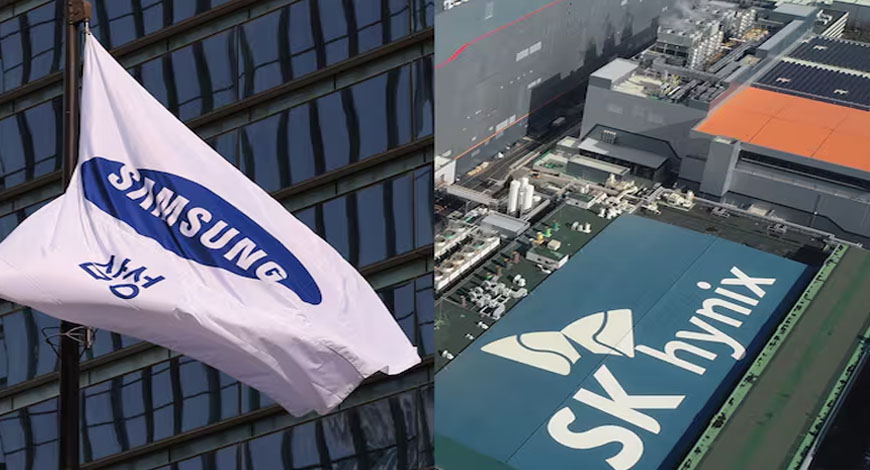
Samsung Electronics and SK hynix are expected to post nearly 100 trillion won in operating profit in the first quarter alone this year, as the memory semiconductor boom continues. However, aside from these two giants, Korea has far fewer global semiconductor companies that can serve as the industry’s backbone compared with other countries.
On April 12, Maeil Business Newspaper analyzed the market capitalization of major global semiconductor companies in dollar terms. Among the 15 companies valued at 100 billion dollars (about 150 trillion won) or more, only two were Korean: Samsung Electronics and SK hynix. This is the second-largest number after the United States, which has 11 such companies.
But when it comes to companies with a corporate value between 10 billion and 100 billion dollars, which effectively form the mid-tier backbone of the semiconductor ecosystem, Korea has only one: HANMI Semiconductor. The gap is stark compared with 14 in the United States, 9 in China, 6 in Taiwan, and 3 in the Netherlands.
Experts point to Korea’s growth model, which has focused heavily on memory semiconductors, as the main reason. In the global semiconductor market, the non-memory segment is larger, and many mid-sized firms operate as fabless design houses or pure-play foundries. Some analysts also argue that the absence of large players in other parts of the ecosystem—such as equipment, packaging, and design houses—suggests that Korea’s national semiconductor strategy has not been sufficiently effective.
China, in particular, has nurtured leading semiconductor companies through aggressive, government-led industrial policies. Semiconductor equipment is one of the sectors that China is fostering as a matter of national priority.
NAURA Technology Group is currently China’s largest semiconductor equipment maker and ranks sixth globally. Formed in 2016 through the merger of Sevenstar Electronics and North Microelectronics (NMC), NAURA has been expanding its scale, including the acquisition of Kingsemi last year.
China supports its domestic semiconductor companies in a variety of ways. In addition to implicit pressure to use domestically made products, it provides massive financial support through investments and subsidies.
China’s leading semiconductor companies have all received investment from the China Integrated Circuit Industry Investment Fund (the Big Fund). The first and second phases of this fund, created to foster the semiconductor industry, totaled about 340 billion yuan and backed corporate growth, and a third phase of 344 billion yuan has now been established.
China has also accelerated growth and driven innovation through entrepreneurship. When companies that received government investment successfully go public, the fund recoups capital and reinvests it back into the semiconductor ecosystem.
Kwon Seokjoon, a professor in the Department of Semiconductor Convergence Engineering at Sungkyunkwan University (SKKU), explained, “In Taiwan, an industrial ecosystem and mutually beneficial cluster have formed around foundry companies, while in China, the central and local governments grant a wide range of direct and indirect benefits to domestic firms.”
Taiwan, home to the world’s largest contract chipmaker, Taiwan Semiconductor Manufacturing Company (TSMC), is highly concentrated around this single firm, whose market capitalization reaches about 1.7 trillion dollars. Even so, Taiwan has far more semiconductor companies in the 10 to 100 billion dollar range than Korea.
This is because the trickle-down effect from TSMC’s growth has naturally spread to other Taiwanese semiconductor companies. As TSMC expanded by serving global tech giants as customers, these related firms also grew alongside it in the global market.
In Taiwan, the next-largest semiconductor company after TSMC is the fabless firm MediaTek. Spun off from United Microelectronics Corporation (UMC) in 1997, MediaTek is a powerhouse in chips for smartphones and Internet of Things (IoT) devices. It dominates the low-cost smartphone and tablet markets.
Design house companies have also formed a vast ecosystem. Design houses support fabless firms and foundries so they can design and manufacture semiconductors more effectively. Global Unichip Corporation (GUC) is a representative Taiwanese company that has grown alongside TSMC. Although it does not sell its own products and operates as a kind of service provider, it has been expanding into a global player by supporting big tech companies as they develop their own in-house chips. Maeil Business










You must be logged in to post a comment Login