
Company News
Microsoft deploys Maia 200 AI chip to reduce NVIDIA reliance
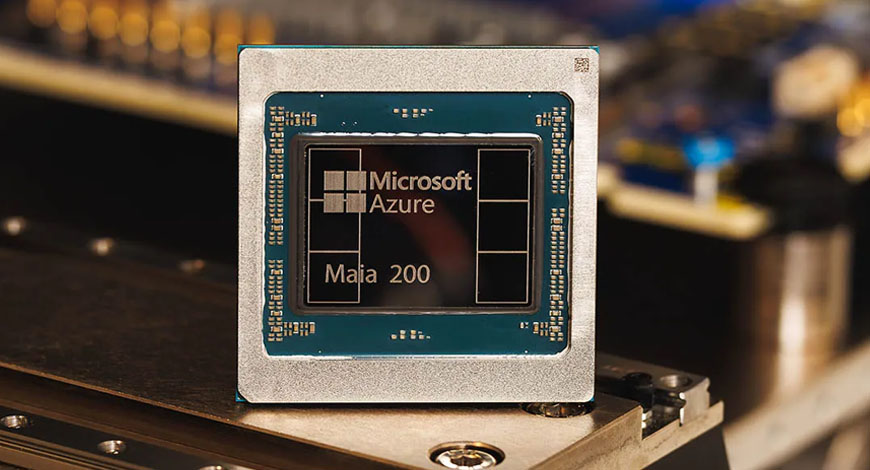
In early last month, “Building 50,” located at the center of Microsoft’s Redmond, Washington campus, resembled a data center in miniature. Inside the room filled with server noises, server racks (metal storage units for equipment) and cooling devices were lined up as if an entire data center had been relocated. This is MS’s “Silicon Lab,” where technical verification of the next-generation AI chip “Maia 200” is conducted.
MS has publicly disclosed for the first time to global media the development and verification process of the “Maia 200.” Among Korean media, this newspaper was the only one to visit. Unveiled earlier this year, the chip boasts industry-leading inference performance and is equipped with SK Hynix’s 5th-generation high-bandwidth memory (HBM3E). Jessica Hawk, Azure vice president, stated, “We will provide customers with optimal price-to-performance ratios by utilizing our own chips alongside NVIDIA’s AI chips.”
In the Silicon Lab, MS designs AI chips and rigorously tests the quality of the Maia 200 received from Taiwanese TSMC in an environment mimicking actual servers. MS has already deployed the Maia 200 in its data center in Dubuque, Iowa, and plans to expand its deployment to other regional data centers, including Atlanta.
Beyond MS, numerous big tech companies are pursuing a “chip diversification” strategy. Google is developing the Tensor Processing Unit (TPU), Amazon Web Services (AWS) the Trainium series, Meta the MTIA, and OpenAI has announced plans to develop its own chip with Broadcom. This diversification strategy among AI companies is favorable for South Korea’s semiconductor industry. As more companies develop proprietary chips, demand for memory semiconductors from Samsung Electronics and SK Hynix will increase. The Chosun












You must be logged in to post a comment Login