
CT’s Take
The hidden cost of AI-semiconductor crunch is reshaping telecom economics
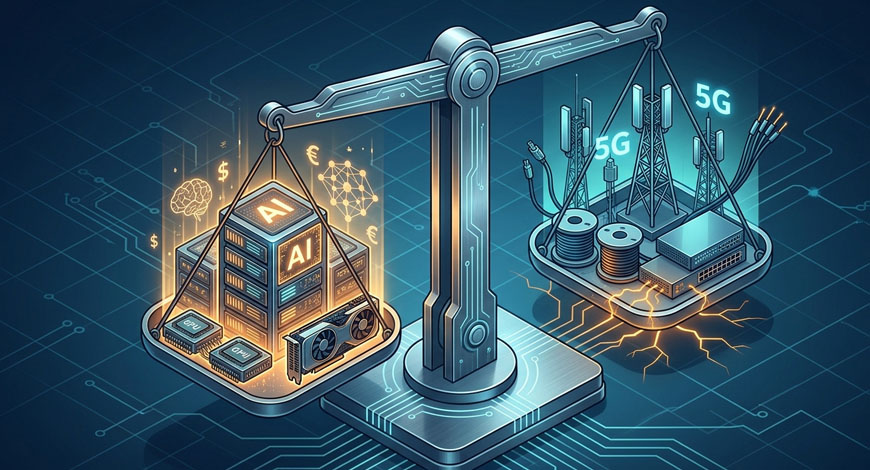
Artificial intelligence is widely celebrated for its potential to drive efficiency and reduce costs across industries, but in one critical sector, it is doing precisely the opposite. The global demand for advanced semiconductors, fueled largely by AI infrastructure build-out, is creating a cascading cost shock that originates in chip fabrication facilities and ultimately ends up on the monthly bills of ordinary consumers.
The supply chain squeeze
At the heart of the issue is a familiar constraint: finite manufacturing capacity for advanced chips. The most sophisticated processor nodes, measured in nanometers, with smaller values indicating greater transistor density and computational efficiency, are produced at just a handful of facilities worldwide. AI infrastructure companies and consumer electronics giants are absorbing the lion’s share of this capacity, leaving other technology sectors to compete for what remains.
Networking and telecommunications equipment manufacturers sit in an uncomfortable middle tier. They require more advanced chips than most industries but are consistently outbid or outprioritized by higher-profile customers. The result is longer lead times, rising component costs, and growing uncertainty in production planning.
Memory chips have been the most visible pressure point. Demand from AI data centers has sent prices soaring, delivering record profits for manufacturers while simultaneously raising input costs for anyone else who relies on the same components, including the makers of routers, base stations, and optical networking hardware. The benefits of this boom are highly concentrated; the burdens are widely distributed.
Telecom infrastructure caught in the middle
For telecom equipment vendors, the timing could hardly be worse. The sector was already navigating a difficult period, marked by weak demand for certain categories of network hardware, softening capital expenditure from major carriers, and the lingering effects of currency fluctuations that have compressed margins in revenue-heavy markets.
Against this backdrop, the additional pressure of rising component costs is particularly unwelcome. Vendors are exploring multiple responses: redesigning products to reduce or substitute expensive components, extending customer negotiations over pricing, and absorbing short-term margin compression in the hope that conditions normalize as chip technology advances.
The expectation within parts of the industry is that relief may arrive once AI and smartphone manufacturers transition to the next generation of chip architectures, theoretically freeing up capacity at current nodes. But this is a hope, not a guarantee, and the transition timeline remains uncertain.
Passing the pain downstream
The more immediate response has been commercial: equipment manufacturers are approaching their telecom operator customers to renegotiate contracts and recover some of the cost increases. This is not an unusual dynamic, it mirrors what happened during pandemic-era supply disruptions, and some operators report that vendors have been forthcoming about the challenges and constructive in working toward solutions.
But the logic of cost pass-through does not stop at the operator level. Telecom carriers facing higher equipment costs have their own margins to protect and their own shareholders to satisfy. The natural outcome is upward pressure on the service fees charged to end users. Consumers who are already expecting to pay more for next-generation smartphones, themselves subject to the same component inflation, may also find that their mobile and broadband tariffs rise in parallel.
Structural fragility
What this episode reveals is a structural fragility in the global technology supply chain that market concentration has made worse. When a single category of demand, AI infrastructure, is large enough and urgent enough to distort pricing across multiple downstream industries, it suggests that the semiconductor supply base is not sufficiently diversified or elastic to absorb such shocks gracefully.
The telecom sector’s experience is a preview of broader dynamics likely to emerge elsewhere. Industries that depend on advanced components but lack the purchasing power or strategic priority of hyperscalers and consumer electronics giants will find themselves perpetually reactive, adjusting plans and prices in response to forces largely outside their control.
For end users, the message is straightforward: the infrastructure that connects them, and the devices they use to access it, is becoming more expensive, and AI demand is a significant reason why. The efficiency gains that AI promises remain largely prospective; the cost increases are already arriving.
CT Bureau


You must be logged in to post a comment Login