
Headlines of the Day
A trillion‑rupee band, no room for cops
India’s public safety broadband story can be told as a flowing, policy driven feature without bullets by leaning on narrative transitions and strong sectioning. Since external resources cannot be accessed in this turn, the following draft relies on the background you already provided and keeps the focus on analysis, not quotes.
A life or death test of spectrum policy
When a riot or a cyclone knocks out conventional lines, the real stress test of India’s telecom policy begins. The government’s ₹20,000 crore plan to upgrade public protection and disaster relief (PPDR) networks is meant to ensure that such communication never fails again. Yet the project is now entangled in a quiet spectrum battle inside the Union government, where decisions taken in closed door meetings on a handful of megahertz could determine how reliably first responders can talk to each other in the next big crisis.
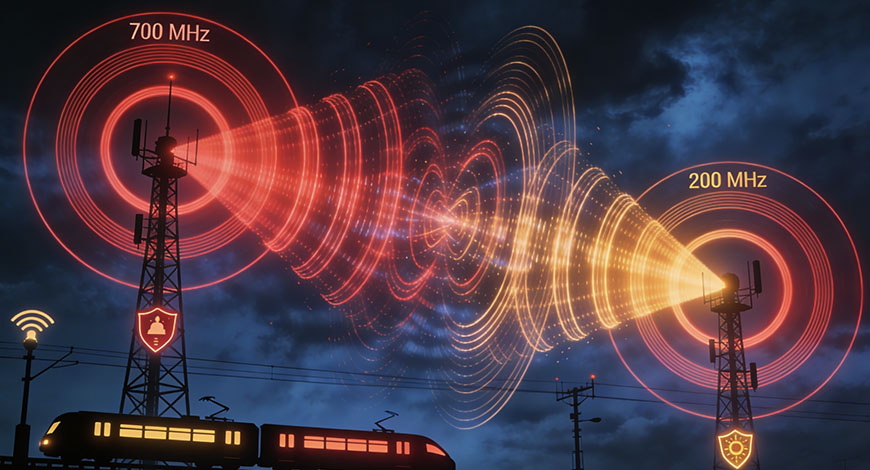
At the heart of this conflict lies the 700 MHz band, one of the most valuable slices of sub GHz spectrum because it combines wide coverage with strong indoor penetration. That combination makes it ideal not only for rural 5G rollouts and transport communications, but also for a nationwide broadband network dedicated to police, fire, medical and disaster response agencies. The Home Ministry’s Directorate of Coordination Police Wireless (DCPW) wants a 10 MHz block in this band to build a modern, secure PPDR network. The telecom side of government, however, has effectively closed that door by arguing that the band is already fully committed and cannot be disturbed at this stage.
How 700 MHz slipped out of PPDR’s reach
The tension is partly the result of past policy choices. Over the last few years, 700 MHz has been progressively carved up among a small group of powerful users: defence, Indian Railways, the National Capital Region Transport Corporation, the state owned BSNL, and a single private operator that bought a nationwide block in the 2022 auction. With these allocations, the entire 45 MHz available in the band is now spoken for, and the residual value of those holdings runs into tens of thousands of crores.
This leaves the PPDR project without a clean, contiguous, nationwide block in what the Home Ministry regards as the ideal band. Instead of redesigning the 700 MHz landscape, the telecom establishment has pointed DCPW towards two alternatives. One is to negotiate priority services on commercial 5G networks operating in 700 MHz, turning public safety into a premium slice on top of operators’ infrastructure. The other is to accept a shift into 800 MHz, where fresh spectrum has been earmarked on paper for PPDR but must first be cleared of legacy users and then harmonised across circles.
NFAP 2025: A nudge towards 800 MHz
The recently notified National Frequency Allocation Plan (NFAP 2025) formalises this pivot. It acknowledges 700 MHz as mostly reserved and instead highlights new possibilities for broadband PPDR in the 800 MHz band, adding to the earlier allocations in 400 MHz that today support narrowband and largely voice centric systems. In doing so, the plan closes the window for building a dedicated 700 MHz PPDR network in the near term, while implicitly assuming that similar performance can be achieved if India leans harder on 800 MHz and modernises the existing 400 MHz base.
On paper, this is defensible. Internationally, both 700 MHz and 800 MHz have been recognised as suitable for broadband PPDR, and a number of Asia Pacific countries are working within a harmonised 700–800 MHz framework. The technical difference between the two bands is not dramatic; devices and network equipment exist for both. The real difficulty with an 800 MHz centric approach in India lies elsewhere: clearing incumbent users, coordinating between multiple ministries and state agencies, and financing a network that must be robust, encrypted and available even when commercial networks fail.
The opportunity cost of prioritising rail and commercial use
By locking 700 MHz into a mix of rail safety systems, defence applications, government owned telephony and a single private 5G network, India has quietly signalled that these uses are more urgent than dedicating prime spectrum to public safety. From a sectoral standpoint, the logic is understandable. Railways need reliable connectivity for systems such as Kavach and for modern train control in metro and regional rapid transit projects. Defence requirements carry obvious strategic weight. A financially stressed BSNL has been promised sub GHz support to remain relevant in the 4G and 5G era. And auctioning a lucrative 700 MHz block to a private operator has brought in substantial one time revenues.
However, this distribution has an opportunity cost that is rarely discussed. A pan India, dedicated PPDR network in 700 MHz would not be a commercial goldmine, but it would provide a common backbone for police, paramilitary, disaster management forces and medical responders across state borders. It could support encrypted broadband links for body worn cameras, high resolution video feeds from drones, real time mapping, and AI driven analytics at incident command centres. These capabilities are hard to deliver reliably through patchwork sharing arrangements or by stitching together disparate bands and legacy systems. The more fragmented the spectrum plan, the more complex and expensive the device ecosystem and network design become for every SP and state police department that must buy into the system.
Execution risk: a ten year project with no room for drift
Even if the Home Ministry ultimately accepts an 800 MHz first roadmap for PPDR, the bigger challenge will be execution. Global experience suggests that building a truly national broadband network for first responders is a decade long effort, even in markets with far fewer institutional stakeholders. It demands detailed harmonisation between the Centre and states, between civilian and security agencies, and between government owned infrastructure and private operator networks. It also requires a clear governance model for who runs the core network, who pays for it, and how priority and pre emption are enforced during emergencies.
India is already starting late. The telecom regulator first sketched out a next generation, 4G/5G based BB PPDR vision several years ago, including the idea of dedicated, no cost spectrum in 800 MHz and a single, integrated national network rather than separate state level islands. Since then, policy energy has been absorbed by high stakes commercial 5G auctions, satellite spectrum debates and preparations for 6G. The PPDR project, meanwhile, has moved in fits and starts, with consultant shortlists being drawn up and then reopened, and no clear build timetable emerging in the public domain.
A decision about values, not just frequencies
The fight over 700 MHz is therefore more than a technical or bureaucratic quarrel. It is a reflection of what the state values most in its spectrum calculus: immediate auction revenue, sector specific modernisation for railways and defence, or a foundational platform for public safety that quietly underpins all other activities. By forcing PPDR to adapt to what is left over, rather than planning spectrum around it, the government risks turning a critical national security network into an afterthought.
If the PPDR project is to meet its original promise, policymakers will eventually have to confront three uncomfortable questions. Should some existing 700 MHz allocations be revisited in the long term to carve out at least a thin, harmonised block for public safety. Can a hybrid model that combines a government owned secure core with shared commercial radio access realistically deliver mission critical reliability during large scale disasters. And are current institutional arrangements within the Centre—split across telecom, home, rail and defence—capable of driving a unified national PPDR architecture, or does the country need a new, empowered vehicle dedicated to this task.
How India answers these questions will determine whether the next generation of first responders operates on a world class broadband safety network, or continues to patch together communications through a maze of bands, agencies and commercial workarounds when every second counts.
CT Bureau








You must be logged in to post a comment Login