
Company News
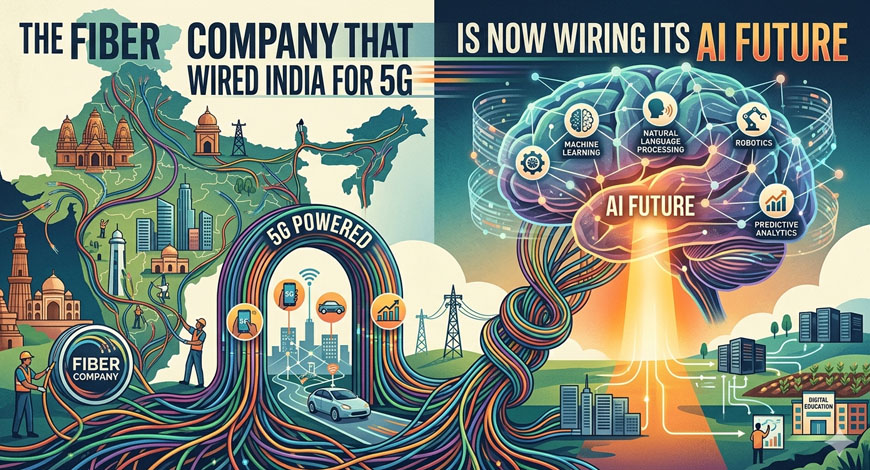
The fiber company that wired India for 5G is now wiring its AI future
India’s equity markets have spent much of 2026 on the wrong side of a global technology rally. The indices that dominate financial headlines, benchmarks heavy with consumer names, financial services companies, and energy conglomerates, have collectively shed over USD 300 billion in market value this year, while Taiwanese chipmakers and South Korean memory producers have surged on the back of AI spending, with no obvious Indian equivalent.
Except that it does. It just doesn’t look like what most investors were searching for.
HFCL Limited has gained 191 percent in 2026. That number is not a rounding error or a momentum trade gone briefly right. It is the market repricing a company, and a category of companies, built for one infrastructure revolution and now indispensable to the next.
The AI CapEx trade nobody saw coming
The logic of AI spending is well understood at the level of chips and software platforms. Less discussed is what lies beneath all of it, the physical layer of fiber, copper, switchgear, transformers, cooling systems, and precision power components, without which no large language model can run a single query and no hyperscale data center can process a single workload.
Every AI inference request travels through infrastructure that requires immense electrical capacity and continuous thermal management. The hardware is power-hungry on a scale with no real precedent in commercial computing history. Global investment in hyperscale data centers is projected to exceed USD 1.2 trillion between 2025 and 2027, a capital deployment cycle that Nomura analysts have characterized as larger than the global 4G wireless rollout, the post-2008 LNG build-out, and the early-2010s shale boom combined.
That capital has to buy something physical. Transformers, cables, cooling units, fiber runs, precision engineering components, the industrial supply chain feeding this expansion has become what Mumbai dealing rooms now call the AI CapEx trade, and it is producing returns that are largely invisible in the headline market numbers precisely because most of the companies generating them sit outside India’s major benchmark indices.
An equal-weighted Bloomberg index tracking 28 Indian companies that feed the data center ecosystem has added approximately USD 47 billion in combined market value this year, a gain of nearly 50 percent, while the NSE Nifty 500 is deeply in the red. The divergence is not incidental. It reflects a structural reallocation of forward earnings expectations from companies exposed to slowing consumption cycles toward companies holding order books that will generate revenue through 2027, 2028, and 2029.
HFCL’s position in the new infrastructure hierarchy
HFCL’s 191 percent rally is grounded in a competitive position that took decades to build, whose value has only recently been recognized by the market. The company developed its fiber-optic cable manufacturing capabilities in service of India’s telecom infrastructure buildout, first the broadband rollout, then the 4G expansion, then the 5G deployment that consumed enormous volumes of fiber as operators raced to densify their networks. That
operational history produced something valuable beyond the cables themselves: manufacturing scale, certified supply relationships, logistical capability, and technical credibility with the kind of large infrastructure customers who cannot afford supply chain failures.
Data center builders are exactly that kind of customer. Hyperscale facilities operating at the power densities AI workloads require need connectivity infrastructure that meets demanding specifications, delivered on schedules that leave no room for delays, and at volumes only established manufacturers can reliably provide. The supply chain competencies that made HFCL a credible vendor for telecom operators translate directly to the data center market, and the data center market is growing faster, at higher margins, with longer contract durations than the telecom cycle that preceded it.
The lead time dynamic reinforces HFCL’s position. Two-to four-year supply timelines for key components have created what amounts to a seller’s market, with manufacturers holding multi-year order backlogs that provide revenue visibility well beyond a typical industrial cycle. Orders being secured through 2025 and 2026 translate into recognized revenue between 2027 and 2029, a forward earnings profile that justifies current valuations in a way that pure thematic momentum cannot.
The hyperscaler spending that anchors the demand
The capital commitments underwriting India’s data center buildout are not speculative. Amazon has announced USD 12.7 billion in cloud infrastructure investment in India through 2030. Alphabet is deploying approximately USD 15 billion on an AI infrastructure hub in Visakhapatnam. A Reliance Industries joint venture has committed to a USD 11 billion data center construction program, while AdaniConnex is building facilities in partnership with Google and Uber.
These are not press release commitments. They are projects that require fiber runs, network integration, cable management systems, and the physical connectivity infrastructure that HFCL and a small number of comparable manufacturers provide. The concentration of announced hyperscaler investment in India, combined with the limited number of qualified domestic suppliers operating at the required scale, has produced exactly the supply constraint that the multi-year lead times reflect.
Foreign institutional investors have already updated their positioning accordingly. Ownership of foreign funds in Indian industrials rose to 14 percent as of end-March, the highest level in two years, even as the same global funds remain record sellers of Indian equities in aggregate. The specificity of that positioning is significant. These are not undifferentiated India allocations rotating with broad emerging market sentiment. They are targeted positions in the industrial supply chain serving data center construction, built by investors who have identified where the AI capex cycle actually creates earnings.
The broader industrial cohort
HFCL’s rally does not exist in isolation. It is the sharpest expression of a theme that runs across a cohort of Indian industrial companies whose common thread is physical supply to the data center ecosystem.
MTAR Technologies, which manufactures precision cooling and power components, has more than tripled this year. Hitachi Energy India, ABB India, and Cummins India have each benefited from the power infrastructure demands that hyperscale data centers place on electrical grids and backup systems. Finolex Cables has gained approximately 36 percent. The common characteristic across this cohort is visible AI-linked earnings growth, not thematic association with AI narratives, but actual order intake and revenue conversion that connects to specific data center construction programs.
Anant Raj, the only listed pure-play data center operator, has gained just 8 percent in the same period, a reminder that proximity to AI infrastructure does not automatically translate to market performance. The market is rewarding the supply chain, not merely the concept.
What the 191 percent actually represents
HFCL’s stock performance in 2026 is ultimately a reflection of a structural repricing, the market updating its assessment of what the company’s capabilities are worth in an era defined by hyperscale AI infrastructure construction rather than consumer broadband expansion.
The company has not changed what it makes. It still manufactures fiber optic cables and provides network integration services. What has changed is the customer base buying those products at scale, the contract duration attached to those orders, the margins available in a market where qualified suppliers are scarce relative to demand, and the forward revenue visibility that multi-year backlog positions provide.
In a year when India’s headline markets are underperforming and the country’s absence from the pure-play AI leaderboard is a recurring conversation, HFCL is a reminder that the question of who benefits from artificial intelligence has a more interesting answer than the one most people are asking. The AI economy needs physical infrastructure. Physical infrastructure needs companies that can build it. And those companies, the ones holding the order books and the supply relationships and the manufacturing capacity, are, right now, some of the best-performing equities in the world.
CT Bureau







You must be logged in to post a comment Login