
Headlines of the Day
India telecom: When mix-shift can no longer substitute for pricing power
The numbers that India’s telecom analysts are watching most closely right now are not subscriber counts, spectrum holdings, or even ARPU trajectories. They are the price of cooking oil, the cost of a cylinder of LPG, and the monthly household budget of the roughly 889 million Indians who now use mobile data, the same consumers whose upgrade behaviour has quietly kept telecom revenues growing even as the industry has held back from a headline tariff increase.
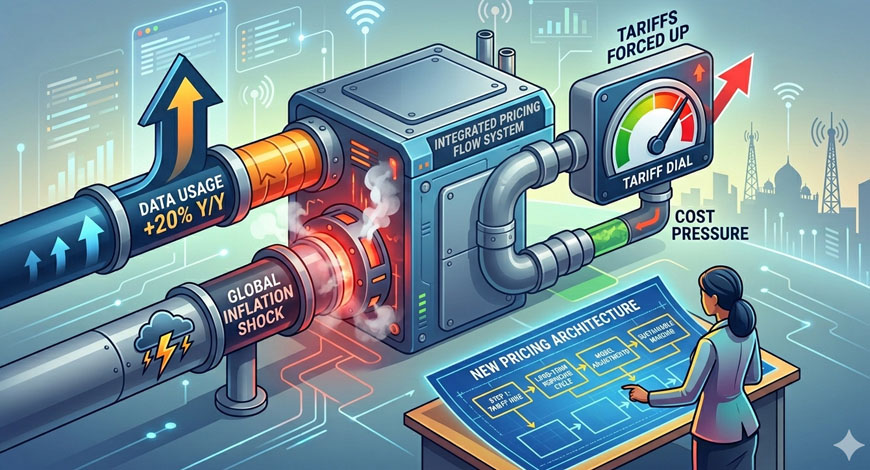
The Iran war has done what domestic policymakers spent years trying to avoid: it has injected a fresh inflationary shock into an economy where household budgets were already stretched, and it has handed India’s telecom operators a politically and commercially awkward problem. They need a tariff hike. The arithmetic is unambiguous, wireless revenue growth slowing to 7% year-on-year in the March quarter, operating income projections for FY27 heavily contingent on a 15% mobile tariff increase materialising by Q2, and the historical pattern clearly established that single-digit revenue growth reliably precedes the next round of price increases. The industry wants to move. The timing is difficult.
What makes this moment particularly revealing is what it exposes about the structural bargain that Indian telecom has been running on since the post-consolidation era stabilised around three private operators, Reliance Jio, Bharti Airtel, and Vodafone Idea. The industry’s growth story for the past several years has not been a pricing story, it has been a migration story. Subscribers moving from non-data to data plans, from entry-level data to higher daily allowances, from prepaid vouchers to monthly bundles. Each step up the consumption ladder has generated incremental revenue without requiring operators to raise the headline price that consumers see and react to. It has been, in effect, a growth strategy built on selling more of something rather than charging more for it.
That strategy has run close to its natural limit. Data-using subscribers now represent 87% of the combined wireless base, a figure that leaves limited headroom for the kind of mix-shift uplift that has buffered revenues in the absence of tariff action. The remaining 13% of non-data users represent the hardest-to-convert segment: typically older, lower-income, or in connectivity environments where data utility remains low. Squeezing meaningful ARPU growth out of that population through organic upgrade behaviour is a diminishing return.
At the same time, data consumption is growing at over 20% year-on-year, a figure that is impressive in isolation and quietly alarming in its monetisation implications. Indians are consuming vastly more data per rupee spent than operators’ current pricing architecture was designed to support. The tariff structure that made sense when average data usage was measured in hundreds of megabytes per day is increasingly misaligned with a usage reality measured in multiple gigabytes. Operators are, in effect, providing a significantly richer service than their pricing reflects, and the gap between what is consumed and what is charged for widens with every passing quarter.
The inflation context from the Iran conflict complicates the timing of correction in ways that go beyond simple consumer sentiment. When household spending is under pressure from rising fuel and food costs, discretionary expenditure gets scrutinised, and while mobile connectivity has become quasi-essential for a vast portion of the Indian population, a ₹50
increase on the 28-day pack is not invisible to a user managing a constrained monthly budget. Telcos are acutely aware that subscriber churn following a tariff hike, even modest churn, would undercut the revenue gain they are trying to capture. The memory of the disruption that followed the July 2024 hike, which this year’s deceleration is, in part, a hangover from, is still fresh enough to counsel caution.
What the industry is really grappling with, beneath the tariff timing question, is a more fundamental repricing challenge. Motilal Oswal, in a note published Friday, made the point directly: beyond the next tariff hike, telcos need to rework their pricing architecture entirely to monetise the secular 20%-plus year-on-year growth in data consumption. A change in tariff architecture, the brokerage argued, could drive higher growth for operators meaningfully, implying that incremental headline price increases alone will not solve the structural mismatch between what Indians consume and what they pay for it.
The India mobile market that emerges from the next tariff cycle will look different from the one that preceded it. Jio, Airtel, and Vi’s combined wireless revenues grew around 10% in FY26 to ₹2.7 lakh crore, a slowdown from 13% in FY25, achieved almost entirely through subscriber mix improvements rather than outright price increases. ICRA estimates ARPU for FY26 rose 8.2% year-on-year to approximately ₹220, and projects a further 3-5% improvement to around ₹230 in FY27, contingent on the anticipated tariff hike materialising. Motilal Oswal expects sector revenue to reach ₹3 lakh crore in FY27 if a 15% tariff increase comes through by the second quarter, translating to 11% on-year growth, a meaningful step up from the single-digit trajectory the industry is currently on.
For consumers, the more honest framing of the current moment is this: the era of effectively unlimited data at near-static prices is drawing to a close, and the only question is the pace and sequencing of the adjustment. The Iran war has brought a few quarters of delay. It has not changed the destination. And when the hike does come, it will arrive not as a one-off correction but as the opening move in a longer repricing of what Indian mobile connectivity is actually worth.
CT Bureau



You must be logged in to post a comment Login