
CT’s Take
Customs duty waiver on wireless-charging parts, to benefit premium smartphone makers
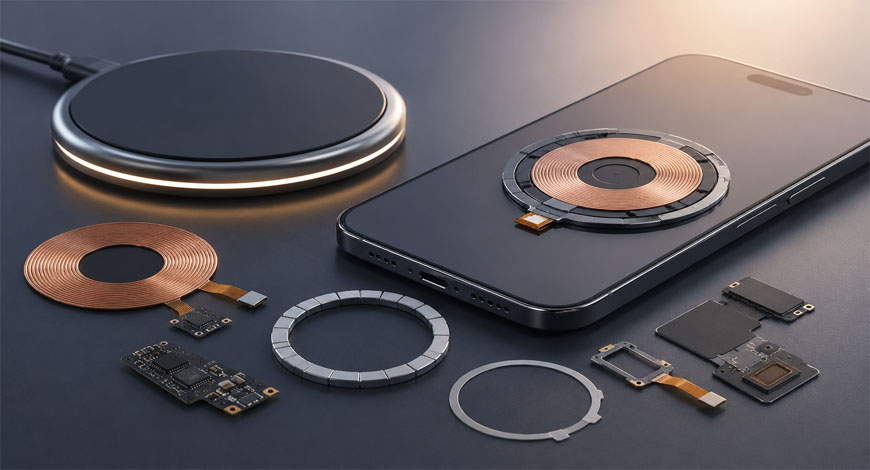
In a move that stands to directly benefit premium smartphone manufacturers, the Central Board of Indirect Taxes and Customs (CBIC) has introduced a “nil” basic customs duty on key components used to build inductor coil modules for wireless charging in mobile phones. The exemption covers nano-crystalline (NC) assemblies, e-shields, PET liners, PC shims (with Z-liner), main stranded coils, NFC coils and Neodymium-Iron-Boron (NdFeB) magnets, inputs concentrated in flagship and premium-tier devices, where wireless charging remains far more common than in budget handsets.
The waiver was issued alongside two related notifications. One exempts customs duty on inputs used in display assemblies, cells, flexible printed circuit assemblies (FPCA), backlight units, frames and anisotropic conductive film (ACF), but only for automotive, medical and industrial applications, explicitly carving out mobile phones, smartwatches and televisions from that particular relief. The other overhauls the list of capital goods eligible for concessional duty in lithium-ion cell manufacturing, expanding it to roughly 85 categories of specialised machinery, from powder dryers and cathode/anode extrusion coating machines to helium leak-testing and laser pin-welding equipment, with CBIC assigning HS code classifications to each to streamline imports. All three measures run through March 31, 2029.
Industry executives framed the changes as a boost to India’s broader manufacturing value chain, not just the smartphone segment. “While the impact on the semiconductor sector is indirect, it is strategically important. Batteries are a core component of modern electronic products, and a competitive domestic battery ecosystem complements India’s semiconductor and electronics manufacturing ambitions,” said Ashok Chandak, president of IESA and SEMI India, adding that the measures would “support end-to-end product creation, deepen supply chain resilience, and enhance India’s position as a trusted global manufacturing hub.”
Pankaj Mohindroo, chairman of the India Cellular and Electronics Association (ICEA), called the display-assembly exemption’s extension to automotive, medical and industrial verticals “an excellent step which will result in building the industry in these verticals as it has happened in mobiles and consumer electronics,” pointing to India’s existing base of display-assembly manufacturing. He added that broadening capital-goods exemptions across the lithium-ion industry, spanning EVs and battery storage systems, would make the sector “more competitive.”
On the government side, IT Secretary S Krishnan said the waivers followed direct industry representations to the finance ministry. “Based on industry representations, this is something that we had taken up with the Ministry of Finance. We are very happy that these notifications have been issued. This will really stimulate the electronics industry, especially the electronic component industry in the country,” he said on the sidelines of the CII GCC Business Summit, adding that the move would help deepen both the value chain and the domestic component ecosystem.
For smartphone makers specifically, the wireless-charging component waiver lowers input costs on a feature increasingly used to differentiate premium models, a narrower but more immediate benefit than the display and battery measures, whose payoff is likely to show up over the multi-year buildout of India’s auto, medtech and battery-manufacturing base.
CT Bureau











You must be logged in to post a comment Login