
CT’s Take
India’s two-speed chip race: OSAT sprints while SCL awaits Cabinet nod
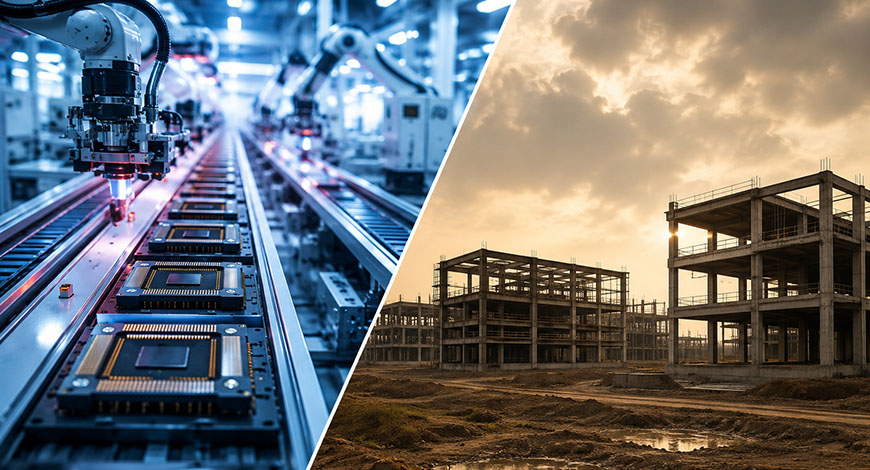
India’s semiconductor ambitions are advancing on two very different clocks. On one track, private capital is racing into chip assembly and testing, with tens of thousands of crores committed and construction already underway. On the other, the country’s only state-owned fabrication facility, a legacy plant with three decades of institutional memory, is stuck waiting for a Cabinet signature. Together, the two stories offer a more complete picture of where India’s chip-making push is working, and where it still stalls.
The fast lane: OSAT takes off
Outsourced Semiconductor Assembly and Test (OSAT) has emerged as India’s most successful entry point into the global chip supply chain. Under the India Semiconductor Mission (ISM), the country has attracted roughly ₹64,000 crore in announced OSAT and ATMP investments, Tata Electronics’ ₹27,000-crore assembly and test plant in Assam, CG Semi’s ₹7,600-crore unit, Kaynes Semicon’s ₹3,300-crore facility, the HCL-Foxconn joint venture’s ₹3,700-crore plant in Uttar Pradesh, and Suchi Semicon’s $100-million facility in Gujarat among them.
The momentum reflects a convergence of factors: government policy that has lowered investment risk through ISM incentives, rising industry participation, growing domestic demand, and a broader global push to diversify chip supply chains away from concentrated hubs. For global investors, the combination has translated into confidence that India can absorb capital quickly and put it to work.
The economics help too. A leading-edge fab can cost $10–25 billion and take years to reach production; a typical OSAT facility costs $300 million to $2 billion and has a far shorter gestation period. For a country with deep design talent, India accounts for over a fifth of the world’s semiconductor design workforce; OSAT lets that talent connect to a physical manufacturing base without the capital intensity of fabrication, building capability, credibility and ecosystem depth before the country moves further up the value chain.
Domestic demand is doing its part as well. Electronics manufacturing is growing rapidly across smartphones, automotive, industrial equipment and telecom, giving OSAT players the advantage of sitting close to both customers and manufacturing partners, while positioning Indian plants as a trusted alternative as global companies diversify away from single-region supply chains. Suchi Semicon’s Gujarat facility, targeting workhorse packages where India currently has zero domestic capacity and full import dependence, plans to begin operations in August, start shipments in September, and reach mass production by May 2027, a timeline that stands in sharp contrast to the pace of India’s legacy fab.
The slow lane: SCL Mohali’s stalled revamp
That contrast is best captured 2,000 kilometres away in Mohali, where the Semiconductor Laboratory (SCL), India’s only state-owned fab, commissioned in 1984 and still recovering, in institutional terms, from a 1989 fire that crippled its operations, is undergoing a very different kind of wait. Six months after Tata Semiconductor Manufacturing, Cyient Semiconductors and Applied Materials were selected in December 2025 to lead a ₹4,500-crore modernization, the project remains stuck awaiting Union Cabinet approval before contracts can even be formally awarded.
The delay is compounded by a parallel expansion plan that requires additional land from the Punjab government, a process complicated by disagreements over pricing and allocation, and by unresolved questions over whether separate expansion contracts might overlap with the modernization mandate already awarded. Until that clarity arrives, the selected partners cannot commit capital or begin on-ground work, even though the technical case for the upgrade is clear: doubling wafer starts from 700 to 1,500 per month on SCL’s legacy 180nm line, which still serves defence, space, industrial and medical-device applications where mature nodes remain in steady demand.
What the gap reveals
The divergence is instructive. OSAT is largely a greenfield, private-sector story, new facilities, new land, incentive structures built specifically for this moment. SCL Mohali is a brownfield, public-sector undertaking layered with legacy infrastructure, inter-ministerial coordination and now a looming alignment with the proposed ₹1.25-trillion Semiconductor Mission 2.0, expected by late 2026. The SCL revamp may well be timed to that broader rollout for financial coherence, but in the meantime it illustrates how execution, not intent, remains India’s binding constraint on the harder parts of the chip value chain.
That distinction matters because OSAT was never meant to be the destination. The durability of India’s semiconductor push will ultimately be judged by whether the country can also build capabilities in materials, equipment, chip design IP, and fabrication itself, reducing reliance on imported technology rather than simply assembling and testing components made elsewhere. The next milestones on that path are already visible: advanced packaging, specialty chemicals, substrates, precision equipment manufacturing, and eventually, selective wafer fabrication.
Seen together, the two stories suggest India has learned how to move fast where the playbook is new. Whether it can apply that same speed to modernizing what it already owns, starting with SCL Mohali, will say more about the durability of its semiconductor ambitions than any single investment announcement.
CT Bureau












You must be logged in to post a comment Login