
Headlines of the Day
The cable that could unravel BharatNet
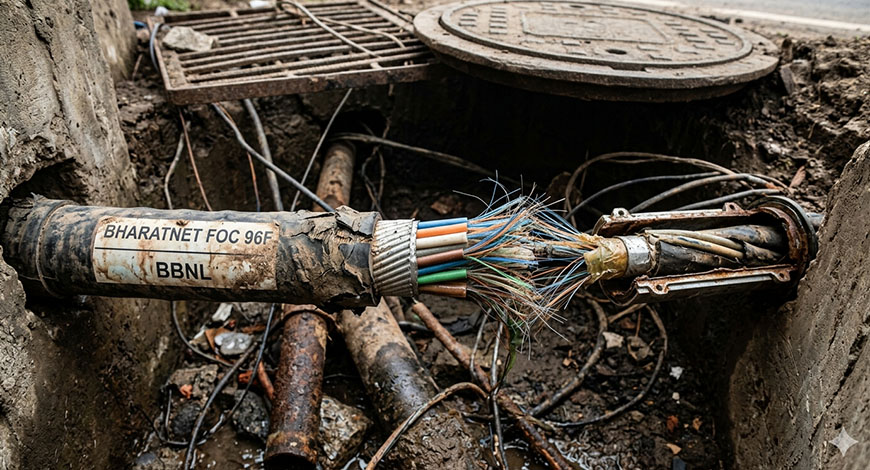
There is a quiet crisis building inside India’s most ambitious digital infrastructure programme. It has nothing to do with spectrum, spectrum policy, or last-mile demand. It is about the price of a cable.
Optical fibre cable (OFC), the physical backbone of BharatNet’s ₹1.39 lakh crore mission to connect every Indian village with high-speed broadband, has roughly doubled in price in less than two years. The flagship G.652D single-mode grade, which was available at around ₹300–325 per fibre-km at the bottom of the last cycle, is now being quoted at ₹700–800. Bend-insensitive G.657A variants have seen comparable or steeper increases in dollar terms. Routers, transport gear, and other active network equipment have followed a similar upward trajectory.
For BSNL, which has floated tenders of around ₹65,000 crore for Phase III under a three-tier architecture covering block-level bandwidth, middle-mile fibre, and last-mile access through the “Udyami” entrepreneur model, the timing could not be worse. Vendors who locked in fixed-price bids based on last cycle’s OFC rates are now staring at a cost structure that the market has structurally repriced beneath them.
AI ate the fibre
To understand what happened to OFC prices, you have to follow the money, and the money is flowing into data centres, not rural India. AI-optimised hyperscale data centres consume five to ten times more fibre optic infrastructure than conventional cloud facilities. Global data centre fibre demand surged 75.9 percent year-on-year in 2025, and this segment is projected to account for 30 percent of total global fibre demand by 2027, up from just 5 percent in 2024.
That demand hit a supply chain that cannot respond quickly. Optical fibre preform manufacturing, the upstream input for cable production, involves highly complex processes with an 18 to 24-month expansion cycle. Capacity simply cannot be dialled up to meet a sudden spike. Chinese G.652D bare fibre prices surged more than 80 percent between November 2025 and January 2026 alone, pulling global prices with them. India is not insulated, domestic manufacturers compete in international markets, and raw material and preform costs are global phenomena.
In other words, the economics of BharatNet Phase III are being disrupted not by anything the government or BSNL did wrong, but by the global AI investment supercycle, and the fibre supply constraints it has exposed.
A programme built on fixed-price assumptions
This matters acutely because of how BharatNet Phase III is structured. Vendors who won tenders take on 10-year build-and-operate obligations, long-duration commitments that were priced on the input cost assumptions prevailing at the time of bidding. When OFC costs double mid-execution, there is no natural mechanism for vendors to pass that through. Margins compress. In some cases, industry participants say, projects risk tipping into loss-making territory.
Earlier, BharatNet contracts included force majeure provisions in operations and maintenance agreements, and government procurement guidance issued during the pandemic acknowledged that abnormal supply chain disruptions could justify relief in specific situations. But force majeure clauses are narrow instruments, they cover discrete shocks, not sustained structural repricing in global commodity markets. A sustained OFC price rally driven by AI data centre demand is unlikely to qualify cleanly under standard force majeure language.
The result is a gap between what the contracts envisaged and what the market now demands, a gap that, if left unaddressed, creates real execution risk.
Phase III cannot afford to slip again
The urgency is not abstract. BharatNet has already missed four major deadlines, in 2014, 2015, 2019, and 2023. As of early 2025, only around 30 percent of India’s 6.5 lakh villages had broadband access under the programme. Phase I and II connected over 2.15 lakh gram panchayats and laid 6.93 lakh km of OFC, a genuine achievement, but they also accumulated a track record of underutilised infrastructure, regional inequalities, and implementation delays that have dogged the programme from the start.
Phase III is meant to be the decisive final push: upgrading middle-mile networks, rolling out FTTH to 1.5 crore households, and saturating 24,680 villages with 4G/5G under the Udyami entrepreneur model, which relies on local Village-Level Entrepreneurs for last-mile operations. HFCL recently won a ₹2,666 crore BharatNet Phase III contract from RVNL for Uttar Pradesh West, covering supply, OFC network creation, commissioning, and 10-year maintenance, precisely the kind of long-duration, fixed-cost commitment that is now under financial strain across the industry.
If cost pressure causes vendors to slow-pedal execution, seek contract renegotiations, or, in extreme cases, walk away from commitments, Phase III will inherit the same delay legacy that has defined its predecessors. And the political cost of that outcome would be high, given the ₹1.39 lakh crore outlay and the prime ministerial priority that rural connectivity has been accorded.
What relief would actually look like
There is no single easy fix, but the options are not obscure. Calibrated price variation mechanisms, written into revised contract conditions, would allow input cost changes beyond a defined threshold to trigger partial adjustment, sharing the risk between the government and the vendor rather than loading it entirely onto the latter. Targeted support for high-cost or difficult terrain areas, where fixed-price economics were always tightest, could prevent the most vulnerable segments from stalling. And tighter but realistic milestones that acknowledge the changed cost environment could prevent a cycle of defaults and penalties that serves no one.
What would be counterproductive is treating this as a law-and-order problem of contract enforcement. Vendors who find themselves underwater on OFC costs because of a global AI-driven commodity cycle are not shirking; they are facing a genuine external shock. The government has, in other infrastructure contexts, recognised the case for contract adaptation when circumstances move materially against original assumptions.
India has spent years and real money building the physical skeleton of rural broadband. Over 42 lakh route kilometers of optical fiber have now been deployed nationally, and data costs have fallen by 96 percent over a decade. The digital inclusion story is real, and the infrastructure base is larger than it has ever been. The irony would be acute if the programme’s final and most ambitious phase, the one designed to close the last-mile gap that has resisted solution for a decade, were derailed not by a failure of vision or investment, but by the cost of a cable.
CT Bureau








You must be logged in to post a comment Login