
Headlines of the Day
Apple’s India inflection: When the factory outlasts the boom
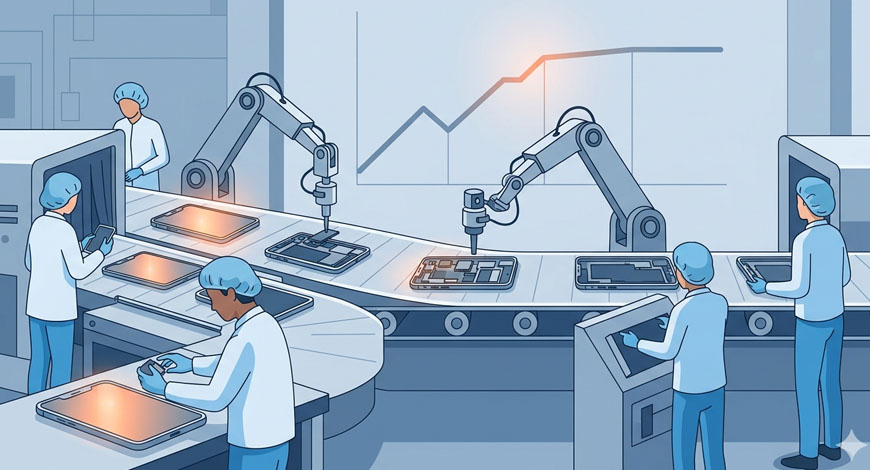
There is a version of Apple’s India story that has been told almost entirely through sales charts, a tenfold rise in iPhone shipments over seven years, market-share dominance in the premium segment, and flagship store openings in Mumbai and Delhi that drew queues stretching around the block. That story, by analyst consensus, is now entering a slower chapter. But the more consequential version of Apple’s India story has little to do with how many iPhones Indians buy, and a great deal to do with how many iPhones India makes.
The deceleration in iPhone unit growth, from breakneck expansion to a projected 7% in 2026, is, in isolation, unremarkable. Markets mature. Premium segments saturate. India’s addressable base for a device priced above 500 dollars remains structurally constrained in a country where the median household income is a fraction of that figure, and where roughly four-fifths of the 150 million smartphones sold annually fall below that threshold. Apple capturing half of the premium segment is an achievement; it is also, arithmetically, close to a ceiling.
What makes India different from other markets where Apple has experienced growth plateaus is that the country has simultaneously become one of its most strategically important manufacturing bases. Apple’s partners, Foxconn at its Tamil Nadu facility, Tata Electronics following its acquisition of Wistron’s operations and its own Hosur plant, are now producing iPhones not merely for domestic sale but for global export. India-made iPhones have reached markets across Europe, the Middle East, and the United States, and Apple has publicly signalled its intent to reduce concentration risk in its supply chain by expanding Indian production capacity significantly. The country is no longer just a destination market, it is a node in Apple’s global manufacturing architecture.
This dual role creates an interesting divergence. Slowing domestic sales growth matters to Apple’s India revenue story and to the premium segment dynamics that local retailers, telco upgrade programs, and accessory ecosystems depend on. But it is largely irrelevant to the manufacturing and export calculus, which is driven by labour costs, logistics infrastructure, government production-linked incentive schemes, and geopolitical supply chain strategy, none of which are sensitive to whether 16 million or 18 million Indians buy new iPhones in a given year.
For the Indian government, this distinction is pointed. New Delhi’s interest in Apple’s presence in India has always been at least as much about manufacturing employment, electronics export targets, and technology transfer as about consumer market development. The production-linked incentive scheme under which Apple’s contract manufacturers have received substantial government support was designed to build an export-capable supply chain, not to subsidise domestic sales. If iPhone unit growth in India plateaus while Apple’s Indian manufacturing capacity continues to expand and export volumes rise, that outcome is, from a policy perspective, broadly acceptable and possibly even preferable to one in which domestic sales boom but production remains offshore.
The services dimension adds a further layer. Apple’s Services segment, App Store revenue, Apple Music, iCloud subscriptions, Apple TV+, is not volume-dependent in the same way hardware sales are. An installed base of 15 to 16 million active iPhones in India, even if it grows slowly in net terms, represents a monetisation opportunity that will compound as per-user service spending rises with income levels and as Apple expands its services portfolio in
the market. The company’s historically low service penetration in India, relative to markets such as the United States and the United Kingdom, is increasingly framed internally as headroom rather than underperformance.
What the current moment really marks is Apple’s transition in India from a growth-market story to a strategic-asset story. The years of triple-digit and double-digit sales growth were when Apple established its brand, built its distribution infrastructure, negotiated its manufacturing partnerships, and secured its position at the top of the premium segment. That phase appears to be closing. What follows is the more complex and potentially more durable phase, one in which India serves Apple simultaneously as a moderately growing consumer market, a large and expanding production hub, a growing services base, and a geopolitical hedge against supply chain concentration in China.
The analysts are right that iPhone growth is slowing. They may be framing the wrong question.
CT Bureau



You must be logged in to post a comment Login