
CT’s Take
India mastered software; now foreign money is all in on hardware
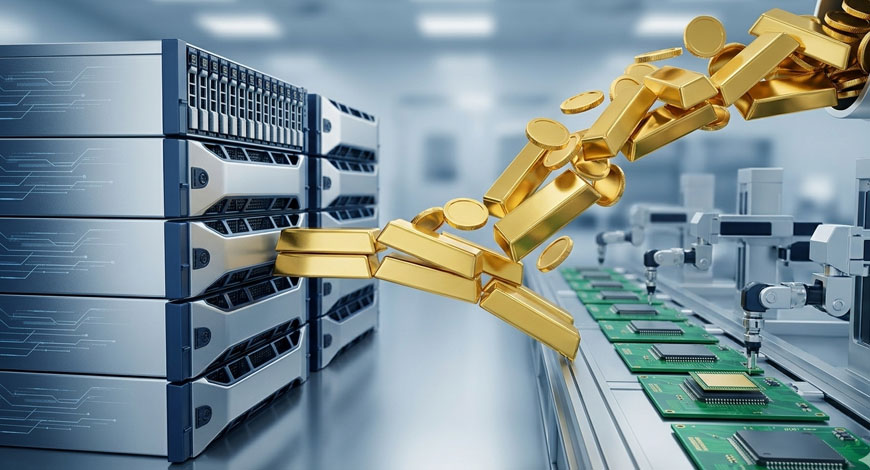
For most of its rise as a technology destination, India’s pitch to the world was defined by code, not components. Software exports, IT services, back-office operations, the country built an internationally recognized identity around what its engineers could produce on screens, not what its factories could assemble or fabricate. The FDI statistics for FY 2025–26, released by the Department for Promotion of Industry and Internal Trade on June 3, 2026, offer the clearest signal yet that foreign capital is beginning to place serious bets on a different India, one that competes not just in software, but in the physical infrastructure of the digital economy.
India received total FDI inflows of US$58.85 billion during FY 2025–26, an 18 percent increase over the previous year, bringing cumulative inflows since April 2000 to an estimated US$1.16 trillion. Within that aggregate, the electronics and semiconductor signal is unmistakable: computer software and hardware together attracted US$13.9 billion in FDI equity inflows, the single largest sectoral recipient, nearly doubling from US$7.8 billion the year prior. For an economy that has historically been categorized as a services destination rather than a manufacturing one, that figure represents a meaningful recategorization.
The semiconductor imperative
Electronics manufacturing has accumulated FDI equity inflows of approximately US$4.9 billion since 2000, a figure that looks modest compared with the scale of investment in Taiwan, South Korea, or even Vietnam. But the trajectory matters more than the stock. India is now explicitly prioritizing semiconductor fabrication, electronic components, and advanced electronics manufacturing through targeted policy incentives, and the investment community is beginning to respond.
The strategic logic driving that response is “China+1”, the global supply chain reconfiguration in which corporations and governments alike are working to reduce geographic concentration risk in the production of semiconductors, PCBs, displays, and electronic assemblies. India’s combination of engineering talent, government industrial policy commitment, and geopolitical alignment with Western technology supply chain partners has positioned it as one of the most credible beneficiaries of that diversification impulse. The Production Linked Incentive scheme for electronics and the emerging semiconductor mission have been specifically designed to translate that strategic positioning into manufacturing reality.
The government has reinforced this with a 60-day fast-track approval mechanism introduced for strategic manufacturing sectors, with electronics components and semiconductors explicitly named among the priority categories. In an industry where investment decisions are often stalled by regulatory uncertainty and approval timelines, the signal that India is prepared to move at commercial speed on these proposals is not trivial.
Japan, the US, and the semiconductor geography of FDI
The source-country composition of FDI inflows this year carries specific significance for electronics and semiconductors. The United States more than doubled its equity inflows to US$11.17 billion, and while that figure encompasses investment across sectors, American semiconductor companies, electronics manufacturers, and technology hardware firms represent a substantial component of US outbound FDI in Asia. The deepening of the US-India technology partnership, including bilateral cooperation frameworks on semiconductor supply chain resilience, provides structural support for continued capital flows in this direction.
Japan’s notable increase in investments is perhaps even more pointed in its sectoral implication. Japanese companies sit at the center of the global semiconductor materials and equipment supply chain. Firms such as Shin-Etsu Chemical, JSR, and Tokyo Electron supply the wafer materials, photoresists, and deposition equipment without which no fabrication facility can operate. Japan’s growing FDI presence in India aligns precisely with the upstream supply chain requirements of India’s semiconductor manufacturing ambitions. These are not passive financial investments, they are the relationships that determine whether India’s chip fabrication ambitions remain aspirational or become operational.
Singapore, which retained its position as India’s largest FDI source at US$19.8 billion, serves as the primary regional conduit through which global technology corporations structure their investments in India. Singapore-domiciled investment vehicles are the channel through which a significant portion of electronics and semiconductor capital enters the Indian market, making Singapore’s continued dominance structurally connected to the hardware investment thesis rather than separable from it.
Karnataka and the GCC-to-fab pipeline
The state-level geography of FDI investment tells a specific story for the electronics and semiconductor sector. Karnataka nearly doubled its inflows to US$12.9 billion, driven by its technology ecosystem, startup landscape, and Global Capability Centers. That GCC concentration matters beyond the software narrative it is usually used to illustrate.
Global Capability Centers in India have been quietly evolving from back-office cost arbitrage operations into genuine engineering and R&D centers. In the semiconductor context, several major chip design companies, including Qualcomm, Intel, Texas Instruments, and Applied Materials, operate significant design and engineering centers in Bengaluru. The expansion of GCC investment in Karnataka is thus partly a story about semiconductor design capability deepening in India, which creates the human capital pipeline that hardware manufacturing requires. Fabrication without design capability is a low-value-add assembly operation; design capability without fabrication is incomplete. Karnataka is becoming the design anchor around which India’s broader semiconductor ambition can cohere.
Maharashtra’s continued position as India’s largest FDI destination at US$18.4 billion adds the manufacturing dimension. The state’s established industrial infrastructure, port connectivity, and existing electronics manufacturing base in clusters around Pune and the Mumbai metropolitan region make it a natural location for the electronics assembly and component manufacturing that precedes and supports semiconductor-level investment.
The growth in states such as Rajasthan and Uttar Pradesh introduces a different dimension, the greenfield electronics manufacturing parks and industrial corridors being developed specifically to attract component manufacturers and consumer electronics assemblers looking for large-format, lower-cost production environments with proximity to India’s massive domestic consumer market.
Telecom’s infrastructure layer
Underneath the semiconductor and electronics investment story runs a telecom infrastructure narrative that the headline FDI figures do not fully surface but that shapes the investment environment significantly. India’s 5G rollout, one of the largest in scale and speed globally, has created immediate demand for network equipment, base stations, radio units, and the associated electronics supply chains. That demand is pulling investment into domestic telecom equipment manufacturing, with policy frameworks explicitly targeting the indigenization of network components that India has historically imported.
The telecom dimension connects directly to the semiconductor story: radio-frequency chips, baseband processors, and power-management ICs for 5G equipment represent some of the most technically demanding semiconductor applications. India’s ambition to move up the value chain in telecom equipment manufacturing, from assembly to component production to chip-level design, is part of the same industrial trajectory reflected in the electronics and semiconductor FDI data.
The credibility gap is narrowing
India’s hardware and electronics manufacturing ambitions have been declared and re-declared across multiple policy cycles without always producing the investment flows needed to validate them. The FY 2025–26 data is notable precisely because the investment is beginning to match the ambition. Computer hardware and software together are the largest sectoral recipients of FDI. Electronics and semiconductor manufacturing explicitly named in the fast-track approval framework. US and Japanese capital are accelerating. Karnataka’s tech ecosystem is deepening into genuine hardware capability.
None of this means India’s transition from a software economy to a hardware competitor is complete or assured. Semiconductor fabrication at scale remains capital-intensive beyond what FDI flows alone can support, and the infrastructure requirements, reliable power, ultra-pure water, precision logistics, are demanding in ways that India’s manufacturing environment is still working to meet.
But the trajectory of capital is directional. Foreign investors who once engaged with India’s technology sector almost exclusively through software services contracts and GCC investments are now placing bets on its physical technology stack, on the chips, components, networks, and manufacturing systems that the digital economy runs on. That shift, more than any individual data point in the FY 2025–26 report, is the story worth watching.
CT Bureau


You must be logged in to post a comment Login