
Headlines of the Day
India’s tech manufacturing ambitions hit China’s chokehold on critical supply chains
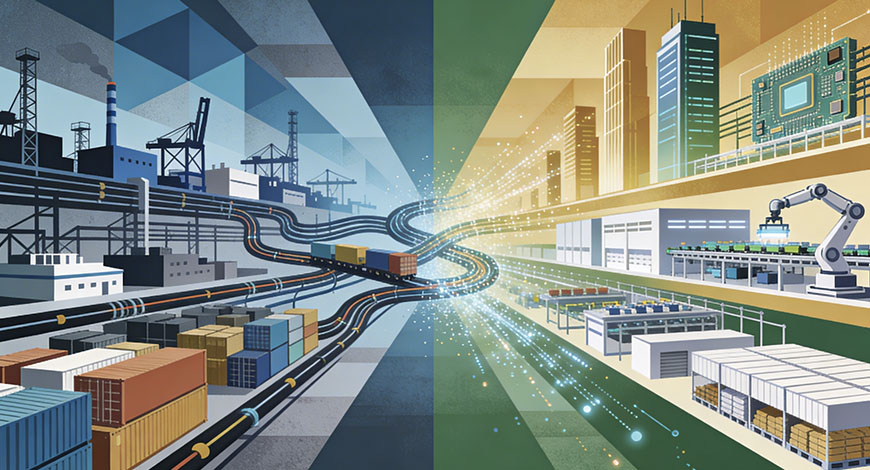
India’s drive to build a world-class domestic manufacturing base in high-technology industries is running into a structural obstacle that billions of dollars in government incentives cannot easily overcome: China’s tightening grip on the core technologies, equipment, and materials that underpin next-generation manufacturing.
Across batteries, semiconductors, electronics, and critical minerals, Indian industry is discovering a common pattern — access to finished products and platforms, but not the underlying knowhow. Beijing has been progressively tightening export controls on key manufacturing equipment and technology, a shift that is hitting India disproportionately hard precisely because it is still in the early stages of building the domestic industrial ecosystem that more advanced economies already possess.
The implications for telecom and enterprise network infrastructure are not incidental. India’s ambitions in 5G equipment manufacturing, network hardware localisation, and the broader electronics supply chain that underpins connectivity infrastructure all trace back to the same dependencies. Display modules, semiconductor components, and the raw material inputs that feed advanced electronics manufacturing remain heavily tied to Chinese supply chains, even as Indian firms and the government pursue indigenisation.
Prime Minister Narendra Modi has set a target of raising manufacturing to 25 percent of GDP, but the data tells a different story — the sector’s contribution has slipped from 17 percent in 2010 to 13 percent in 2024, according to the World Bank. China’s new restrictions threaten to widen that gap further.
“Unlike in the previous two decades, the global economic, trade and geopolitical landscapes have turned into a hostile rather than conducive environment for countries seeking to follow the traditional development path built around manufacturing-intensive, export-led growth,” said Eswar Prasad, professor of trade at Cornell University. China’s determination to ring-fence its prowess in new-technology industries, he warned, could leave India competing at the lower end of the manufacturing spectrum.
The semiconductor sector illustrates the bind most sharply. India’s emerging chip fabrication capacity, anchored by a flagship plant in Gujarat, is sourcing high-end equipment from the US, Europe, Japan, and South Korea — but supporting raw materials and tooling remain partially dependent on Chinese supply chains in the near term, adding cost and complexity that have already introduced uncertainty into production timelines.
In electronics assembly, India has made measurable gains — it now produces a significant share of global smartphone output, with further expansion expected. Yet the higher-value component manufacturing and specialised production equipment that sit above assembly in the value chain continue to originate largely from Chinese industrial networks.
India has attempted to navigate this tension pragmatically, selectively easing investment screening rules in strategic sectors including electronics components, semiconductors, and rare earth processing to allow carefully structured foreign participation. Recent approvals for joint ventures in display module manufacturing signal that New Delhi is not categorically opposed to Chinese capital where it serves domestic industrial goals — but access to technology and knowhow remains a different matter.
Beijing, meanwhile, has tightened visa approvals for Indian professionals travelling to China for technical training, compressing one of the informal channels through which capability transfer has historically occurred.
“China’s curbs on core manufacturing technologies aren’t India-specific, but the effect on India is likely disproportionate,” said Michael Deng, geoeconomics technology analyst at Bloomberg Economics. With alternatives from Japan, South Korea, and Europe available but costlier and slower to scale, India faces a race against time to build the upstream supply chain resilience that its manufacturing ambitions require.
For the telecom and enterprise technology sectors, the message is pointed: indigenisation strategies that rely on component and equipment supply chains still rooted in Chinese manufacturing face a vulnerability that policy alone cannot quickly resolve.
CT Bureau


You must be logged in to post a comment Login